

Last Updated on September 30, 2026
Quick answer: The biggest college in the U.S. depends on how you measure it. Texas A&M University at College Station is the largest single campus, with 74,407 students in fall 2025. Arizona State University is the largest public university by total enrollment, counting ASU Online. Berry College in Georgia has the largest campus by land, at about 27,000 acres.
Choosing a large or small school is a big part of your college selection process. Life at a tight-knit campus looks very different from life at a large university, from class sizes and student-to-faculty ratios to campus amenities and community.
So what is the biggest college in the U.S.? That depends on whether you measure “big” by enrollment or by land. Below, we cover the largest colleges and universities in the country by each measure, what student life is like at each, and how to decide whether a big school is the right fit for you.
How Do You Measure the Biggest College in the U.S.?
There are several common ways to rank the size of a college, and each one produces a different answer:
- Largest single-campus enrollment: The number of students attending classes at one campus. This is the measure most often used by the media and higher education analysts.
- Largest total enrollment: The headcount across all of a university’s campuses, sometimes including online students.
- Largest campus by land: The acreage of a campus, which can look very different from enrollment numbers.
Enrollment figures also depend on when they are counted. Most universities report a fall “census” headcount, while some also report every student enrolled at any point in the year, which produces a much larger number. The U.S. Department of Education’s College Navigator lists official fall enrollment for every accredited college, which makes it a useful place to compare schools on the same basis. Here is how the biggest colleges compare at a glance:
| Measure | College | Size |
|---|---|---|
| Largest single campus | Texas A&M University, College Station | 74,407 students (fall 2025) |
| Largest public university by total enrollment | Arizona State University | More than 203,700 students, including ASU Online (2025–26, full year) |
| Largest campus by land | Berry College | 27,000 acres |
The Biggest College by Single-Campus Enrollment: Texas A&M University
The largest single-campus college in the United States is Texas A&M University at College Station, which enrolled 74,407 students on its flagship campus in fall 2025, and 81,354 across the whole university. [1] The school has operated in College Station since 1876, and the result is a true college town with deep school spirit and a massive football fanbase.
What Is Student Life Like at Texas A&M?
Texas A&M offers a single-campus experience that feels like its own self-contained city. Long-standing traditions bring students together with Aggie spirit, including the official greeting of “Howdy,” the “12th Man” football fanbase, and Midnight Yell Practice, a high-energy pep rally before home games. [2] Students also take part in the Big Event, one of the largest student-run service projects in the country.
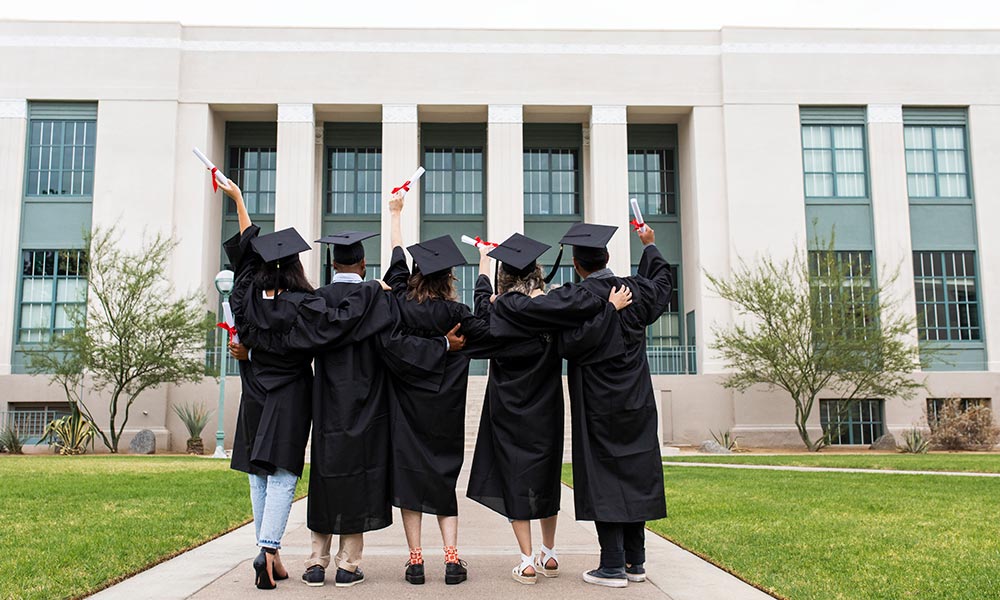
A&M has more than 1,300 recognized student organizations, including the Corps of Cadets, and a campus of about 5,200 acres with multiple academic districts and research facilities. Despite the size of the student body, Aggies often describe the culture as close-knit.
The Biggest College by Total Enrollment: Arizona State University
Arizona State University (ASU) is the largest public university in the country by total enrollment. Counting every term of the year and ASU Online, ASU enrolled more than 203,700 students in 2025–26. [3] That full-year count is not directly comparable to the fall snapshots used for most other schools, but it shows how far ASU’s reach extends.
Looking only at in-person students, ASU enrolled 78,510 students across its Phoenix-area campuses in fall 2025, including 64,662 undergraduates, with Tempe the largest campus. [4] For students who want a traditional on-campus experience, ASU offers a large community that spans several locations.
What Is Student Life Like at ASU Tempe?
A college with a large enrollment and a relatively compact main campus, like ASU Tempe, can feel like a small city. Students find smaller communities in residence halls, labs, studios, maker spaces, and clubs. For a more intimate experience, Barrett, The Honors College offers a residential college feel with access to the resources of a major research university. [5]
ASU’s campuses are connected by shuttles and light rail, and Tempe is walkable and bikeable. After graduation, students have access to Phoenix-area employers in growing fields such as aerospace, semiconductors, health care, and supply chain management.
The Biggest College by Campus Size: Berry College
Berry College in Mount Berry, Georgia, has the largest campus in the U.S. and describes itself as the world’s largest campus, at about 27,000 acres. [6] Berry is also known for its student work program, which lets students hold on-campus jobs throughout their four years and build real work experience before graduation. Martha Berry founded the school in 1902, and today its land includes forests, farmland, and miles of trails, much of it cared for with help from students in campus jobs.
What Is Student Life Like at Berry College?
Berry enrolls about 2,100 students, [6] so its huge campus pairs with a small-college experience. Classes are small, students get to know their professors, and the pace is quieter than on a city campus.
Students enjoy forests, lakes, and meadows for hiking, biking, and other outdoor activities, and deer and wild turkeys roam the grounds. Berry also has equestrian facilities and field research sites for environmental science and ecology.
Other Large Colleges and Universities in the U.S.
Beyond Texas A&M, ASU, and Berry College, several other universities enroll some of the largest student bodies in the country. Enrollment at many of these schools has grown in recent years, so check each school’s official facts page for the latest figures before you apply.
- University of Central Florida (UCF): About 70,700 students across its locations and UCF Online in fall 2025. UCF is known for programs in optics and photonics, modeling and simulation, hospitality management, and game design.
- Ohio State University: About 67,000 students across its campuses, most of them in Columbus, with well-known athletics and research programs in engineering, business, and medicine.
- University of Florida: About 57,400 students in Gainesville, with a major research profile and programs in engineering, business, and the sciences.
- Florida International University (FIU): About 50,000 degree-seeking students in Miami, with a large, diverse student body and research programs in international business and hospitality.
- Penn State University Park: About 42,800 undergraduates, a vibrant college-town culture in State College, and programs in education, business, and engineering.
- Rutgers University–New Brunswick: Nearly 47,000 students, with programs in pharmacy, business, and political science.
Is a Big College Right for You?
Size shapes almost every part of college life, so it is worth thinking about what you want before you build your college list. Large universities usually offer more majors, research opportunities, clubs, and athletic events, plus a big alumni network. They also tend to have larger introductory classes and more students per faculty member, so you may need to take more initiative to get to know your professors.
Large and small schools can both lead to excellent outcomes; what matters most is how well a school’s environment matches the way you learn. Smaller colleges offer small classes, close relationships with faculty, and a tight community, but they may have fewer majors and less variety in campus life. Many large universities close that gap with honors colleges, living-learning communities, and smaller programs within the larger school.
Size can also shape your admissions strategy. Large public universities often admit students by major or college, so getting into engineering or computer science can be much more competitive than getting into the university overall. Many also give priority to in-state applicants. Smaller private colleges tend to use a more individualized review and may weigh fit and your interest in the school more heavily.
As you compare schools, ask a few practical questions:
- How large are introductory classes in the major you want, and who teaches them?
- How easy is it to get into required courses, and do most students graduate in four years?
- Does the university have an honors college or living-learning community that creates a smaller home base?
- What research, internship, and advising support is available to undergraduates?
Balance your list with schools of different sizes and levels of selectivity. If a close community appeals to you, the Little Ivies are worth a look. To understand how colleges track which admitted students actually enroll, read our guide to college yield rates.
To find the right fit, visit campuses of different sizes, sit in on a class if you can, and ask current students how easy it is to get into the courses they need. The best choice depends on how you learn, the programs you want, and the kind of community where you will do your best work.
Ready to Take the Next Step?
Get a clear, honest read on which path actually fits your goals, and the specific next steps to build a competitive application. Click here to book your complimentary consultation.