
The Transfer Equation: Who Should Transfer, When It Works, and What It Costs
A data-driven guide to transfer decisions at highly selective universities
By Lindsey Kundel, Editor in Chief, InGenius Prep
INTRODUCTION
Why Transfer Feels Urgent—and Why Urgency Is the Wrong Lens
Every January, the same quiet question begins to surface in families’ conversations.
Sometimes it is spoken plainly. More often, it hovers just beneath the surface—raised cautiously, or typed late at night into a search bar:
Should we think about transferring?
Transfer is not an edge case. According to the National Student Clearinghouse Research Center, transfer enrollment represented about 13.1% of all continuing and returning undergraduate students in fall 2024, up from 11.9% in fall 2020 — the result of nearly 1.2 million students changing institutions in a single year, up roughly 4.4% from the prior year.
Transfer mobility is a central characteristic of U.S. higher education: roughly one-third of college students transfer institutions at least once within 5–6 years. However, research shows that pathways, experiences, and outcomes vary significantly by institutional context and transfer policy.
The reasons for transferring vary. An early admissions outcome didn’t go as hoped. A first-semester college transcript feels more sobering than expected. A student who once seemed confident now sounds uncertain—about their major, their peers, or their place. Comparisons creep in. So does the sense that a decision made months or years ago may have closed doors that matter.
In these moments, transfer can feel like agency. Like movement. Like a way to reclaim control in a process that suddenly feels unforgiving.
This paper begins from a simple premise: those feelings are understandable—and they deserve better guidance than most families receive.
Transfer Is Not a Failure—But It Is Not Neutral
Historically, research shows that more than one-third (37.2%) of college students transfer at least once within six years, illustrating that non-linear college pathways are more common than the traditional “straight through” narrative suggests.
Transfer carries cultural baggage. For some families, it still signals failure or retreat. For others, it has been recast as a savvy workaround—proof that ambition can outmaneuver disappointment.
Recent data also complicate the idea that transfer is inherently risky or regressive. New analyses from the National Student Clearinghouse Research Center show that transfer rates are rising across multiple student populations, including first-generation students, Pell recipients, and students from historically underserved backgrounds. In particular, upward and lateral transfers have increased steadily since the pandemic, suggesting that transfer is increasingly functioning as a legitimate—and sometimes necessary—pathway through higher education rather than a signal of derailment.
This is, in many ways, good news. It reflects improved articulation, stronger advising in some sectors, and growing recognition that educational trajectories are rarely linear. But rising transfer volume does not mean transfer works equally well in all contexts. Outcomes remain highly sensitive to institutional type, transfer timing, credit policy, and major access—especially at highly selective private universities. Growth alone does not eliminate risk; it simply makes clarity more urgent.
Both frames are incomplete.
Transfer is neither a moral verdict nor a guaranteed upgrade. It is a structural intervention in a system governed by capacity, timing, and tradeoffs. It can open doors—but it can also quietly extend timelines, increase cost, and disrupt momentum in ways that only become visible years later.
The problem is not that families consider transfer. The problem is that they are often forced to do so without a clear map of how transfer actually works—and without language for distinguishing between emotional discomfort and structural misalignment.
Why This Conversation Is So Hard to Get Right
Transfer sits at the intersection of three forces that rarely align cleanly:
- Emotion
Disappointment, anxiety, and comparison pressure are real—and powerful. They narrow time horizons and amplify the appeal of decisive action. - Institutional reality
Colleges do not admit transfers to reward persistence or ambition. They admit them to manage enrollment, backfill attrition, and balance programs. These incentives are rarely explained clearly to families. - Incomplete information
Acceptance rates are published, but capacity is not. Credit policies are listed, but their impact is unclear until after decisions are made. Financial aid rules shift quietly between first-year and transfer cohorts.
When these forces collide, families are left to navigate one of the most consequential decisions in higher education with partial data and borrowed assumptions.
What This Paper Is—and What It Is Not
This white paper is not a pitch for transfer. It is also not an argument against it.
It is designed to do something more difficult—and more necessary:
- Show the real math behind transfer admissions
- Correct common myths about selectivity and accessibility
- Explain why colleges accept transfers in the first place
- Name the academic, financial, and identity costs honestly
- Clarify when transfer helps—and when it likely doesn’t
- Offer a decision framework that prioritizes strategy over panic
Throughout, the goal is not to tell families what to choose. It is to help them choose deliberately, with a clear understanding of what they are trading—and what they might gain.
A Humane Starting Point
Students who consider transfer are often carrying more than transcripts and résumés. They may be carrying shame, self-doubt, or the fear that they have already fallen behind in a race they didn’t realize they were running.
This paper rejects that framing.
Educational paths are not linear. Fit is not always obvious at 18. And changing course—when done thoughtfully—is not evidence of weakness. But neither is staying put and redesigning the experience from within.
The work, then, is not to move quickly. It is to diagnose carefully.
What follows is an attempt to slow the conversation down just enough to make it clearer—so that whatever decision comes next is rooted not in fear, but in strategy.
SECTION 1
Why Transfer Conversations Are Increasing

Transfer is not a new phenomenon in higher education, but the frequency, urgency, and emotional charge surrounding transfer conversations have changed markedly in recent years.
Each January, a predictable pattern emerges. Early admission results arrive. First-semester college grades surface. Students begin to compare themselves—often harshly—to peers at other institutions or in other majors. Families who felt confident in August quietly begin to search for alternatives. Transfer becomes the word that sits unspoken at the dinner table, then typed into Google late at night.
What’s important to say upfront is this: the rise in transfer conversations is not a sign that students are weaker, less prepared, or less resilient than past generations. It is a rational response to a system that has become more complex, more stratified, and more opaque—particularly at highly selective institutions.
Understanding why transfer conversations are increasing is essential before evaluating whether transferring is actually the right move.
1.1 January as an Emotional Inflection Point
January is not just another month in the admissions cycle. It is an emotional bottleneck.
For first-year applicants, January often brings:
- Early Action or Early Decision outcomes that did not go as hoped
- The realization that Regular Decision odds are far longer than expected
- A sense of being “behind” peers who appear to have landed somewhere more prestigious or more aligned
For college freshmen, January introduces a different reckoning:
- First-semester grades replace high school transcripts as the dominant academic signal
- Initial impressions of campus life harden into narratives about fit, belonging, and identity
- Major access rules—especially in STEM, business, and engineering—become visible for the first time
At this moment, transfer can feel less like a strategic option and more like an emotional lifeline: a way to undo a choice that suddenly feels permanent.
But emotional urgency is not the same thing as strategic clarity. In fact, January is often the worst time to make a high-stakes decision without a framework.
Nationally, transfer enrollment patterns represent a significant portion of undergraduate mobility — transfers accounted for 13.2% of undergraduates in fall 2023, reflecting a consistent presence of moving students across U.S. colleges.
Table 1.1 — Common January Triggers Behind Transfer Interest
| Category | Typical Trigger | What It Often Masks |
| Admissions | Early results disappointment | Overestimation of transfer selectivity |
| Academics | First-semester GPA shock | Transitional adjustment period |
| Social | Belonging discomfort | Normal first-year dislocation |
| Majors | Inability to enter desired major | Lack of early advising |
| Comparison | Peer outcomes | Status anxiety, not misfit |
This table matters because it reframes January stress as diagnostic, not determinative. Many of these triggers signal areas that need attention—but not necessarily relocation.
1.2 Structural Drivers: Why This Moment Is Different
While January has always been emotionally charged, today’s transfer conversations are intensified by structural shifts in higher education.
First, academic pathways are narrower than families realize.
Transfer pathways are not only complex; they shift over time. For example, while the vertical transfer path from two-year to four-year institutions remains common, the share of such transfers has decreased since fall 2020 even as overall transfer numbers grow.
Capacity-managed majors—especially computer science, engineering, data science, business, and economics—often operate independently from general admission. Students may be admitted to a university without any guaranteed path into their intended field. This discovery frequently occurs after matriculation, when internal transfer policies are harder to navigate.
Second, institutional transparency has not kept pace with institutional complexity.
Families are often given high-level messaging (“You can explore,” “You’re not locked in”) without clear guidance on:
- prerequisite sequencing
- major caps
- GPA thresholds
- credit applicability
When reality collides with expectation, transfer begins to look like a solution rather than a symptom.
Third, post-pandemic cohorts are still recalibrating.
Interrupted schooling, online-to-in-person transitions, and uneven academic preparation have made the first year of college more volatile. For some students, this volatility reflects a true mismatch. For many others, it reflects an unfinished adjustment process.
These trends are also playing out unevenly across student populations. Recent reporting shows that transfer rates are rising fastest among students from lower-income backgrounds, first-generation students, and students of color—groups for whom institutional fit, financial stability, and geographic feasibility are often more volatile. For these students, transfer is less about optimization and more about persistence.
This context matters. It underscores why transfer cannot be evaluated through a single moral or strategic frame. For some students, transfer represents upward mobility or renewed access. For others—particularly in capacity-constrained, highly selective environments—it introduces new risks that are less visible at the point of decision.
Finally, outcome visibility has increased.
Research suggests that transfer intentions are not random: when students pause or leave after stopping out, 52% were returning learners who re-enrolled and then transferred, indicating diverse motives beyond simple academic disillusionment.
Internship announcements, LinkedIn acceptances, and early career signaling now arrive earlier—and louder—than ever. Students don’t just wonder whether they are doing “well”; they wonder whether they chose the right launchpad.
Visual 1.1 — Emotional vs. Structural Drivers of Transfer Interest
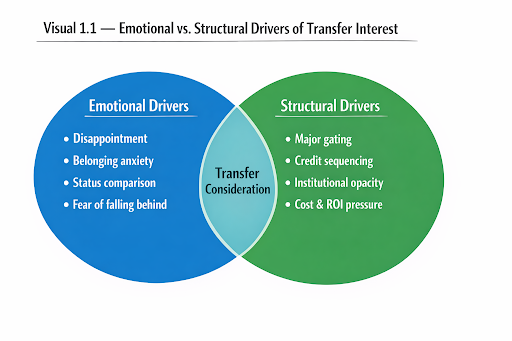
This diagram reinforces a critical point: transfer interest often arises at the intersection of emotion and structure. Effective guidance requires addressing both—without letting either dominate the decision.
1.3 The Risk of Reactive Decision-Making
When transfer is framed primarily as a response to discomfort, disappointment, or comparison, families are vulnerable to three common mistakes:
- Overestimating the accessibility of elite transfer pathways
- Underestimating the academic and financial cost of moving
- Mistaking emotional relief for long-term fit
This paper is not anti-transfer. But it is firmly opposed to panic-driven mobility—especially in a system where transfer seats are limited, credits do not move cleanly, and graduation timelines can quietly extend.
Before asking “Where else could I go?” the more productive question is often: “What exactly isn’t working—and is transfer the only way to fix it?” That question becomes the foundation for everything that follows.
SECTION 2
How Transfer Admissions Actually Work

Timing, Mechanics, and Why the Process Feels Unfamiliar
While transfer admissions are less visible, nationally they represent a material enrollment segment: about 1 in 8 continuing undergraduates transferred to another institution within a year, indicating that colleges are managing significant mobility.
For those considering transferring colleges, one of the most destabilizing aspects of transfer planning is not selectivity—it is procedural confusion.
Families often assume that transfer admissions operate as a parallel version of first-year admissions: similar timelines, similar rules, similar logic, just a different applicant pool. In reality, transfer admissions are governed by a fundamentally different set of institutional priorities. Understanding those differences is essential before interpreting acceptance rates, deadlines, or outcomes.
Transfer admissions are not designed to build a class. They are designed to manage capacity.
2.1 First-Year Admissions vs. Transfer Admissions: Two Different Systems
First-year admissions and transfer admissions serve different institutional functions—and are therefore structured very differently.
First-year admissions exist to:
- shape an incoming cohort
- balance academic, geographic, and demographic priorities
- manage yield at scale
- plan housing, advising, and course capacity years in advance
Transfer admissions exist to:
- backfill seats created by attrition
- stabilize enrollment in specific programs or years
- respond to uneven retention across majors
- address short-term capacity gaps
This distinction explains why transfer admissions often feel opaque, fragmented, and unpredictable. They are not built around a single moment or a single cohort; they are built around residual space.
Table 2.1 — First-Year Admissions vs. Transfer Admissions
| Dimension | First-Year Admissions | Transfer Admissions |
| Core purpose | Build a cohort | Fill residual capacity |
| Planning horizon | Multi-year | Short-term |
| Seat availability | Known in advance | Emerges from attrition |
| Major access | Often flexible | Often tightly gated |
| Calendar | Centralized | School-specific, staggered |
| Yield modeling | Extensive | Limited and reactive |
This table is foundational. It reframes transfer not as a second chance at the same process, but as entry into a different admissions market entirely.
2.2 Transfer Intake Types and Patterns
Unlike first-year admissions, which typically culminate in a single fall intake, transfer admissions operate across multiple entry points—each with its own constraints.
Fall transfer is the most common intake and typically offers the greatest number of available seats. Even then, availability varies significantly by year, major, and institution.
Spring transfer exists at some institutions but is usually more limited. Spring entrants often face:
- reduced course availability
- delayed access to major sequences
- housing challenges
Sophomore vs. junior transfer patterns further complicate planning.
At many highly selective private universities:
- transfer cohorts skew heavily toward junior entry
- sophomore transfer is possible but less common
- students transferring earlier than junior year often face stricter credit evaluation
These patterns are rarely advertised clearly, but they matter enormously for time-to-degree planning.
2.3 The Transfer Timeline: What Actually Happens, Month by Month
Transfer planning does not begin when applications open. It begins much earlier—often before students realize they are “planning” at all.
Transfer planning is often reactive because students do not get data on institutional capacity until late in the cycle; nationally, upward mobility from two-year to four-year institutions grew significantly in recent years, while lateral transfers also climbed — evidence that transfer timing matters at scale.
Table 2.2 — Typical Transfer Timeline
| Period | What Students Experience | What Institutions Are Doing |
| Aug–Sep | Academic adjustment; early discomfort | Monitoring enrollment stability |
| Oct | Advising conversations begin | Assessing early attrition signals |
| Nov–Dec | Researching transfer options | Opening select transfer applications |
| Jan | First-semester grades arrive | Refining capacity estimates |
| Feb–Mar | Application submissions | Reviewing transfer files |
| Apr–May | Decisions released | Finalizing seat allocation |
| Jun–Jul | Credit evaluation, housing | Registration and onboarding |
| Aug | Transition to the new campus | Managing late adjustments |
What this table reveals is a key truth: students are often reacting to January emotions while institutions are still calculating capacity. This mismatch creates both anxiety and unrealistic expectations.
2.4 The Mechanics Families Most Often Underestimate
Even when students gain admission as transfers, the most consequential decisions occur after the acceptance letter arrives.
Credit transfer is not binary.
Credits may be:
- accepted but not applicable to the major
- accepted as electives only
- rejected outright due to sequencing or content mismatch
This distinction—between credits transferring and credits counting—is one of the most common sources of delayed graduation.
GPA rules vary by institution.
At many universities:
- transfer credits do not carry GPA
- students effectively begin a new GPA record
Yet transfer admissions decisions still rely heavily on college GPA trajectory, not high school performance.
Major entry is often separate from admission.
Being admitted to a university does not guarantee entry into a desired major. In capacity-managed fields, students may be admitted with the expectation that:
- additional prerequisites must be completed
- GPA thresholds must be met
- space may or may not be available
Letters of recommendation shift in importance.
Transfer applicants are typically expected to submit letters from college faculty, not high school teachers. This requires:
- early engagement
- office hours
- academic visibility within the first six to eight weeks of college
International students face additional constraints.
Transfer timing must align with:
- enrollment status requirements
- documentation timelines
- start-term restrictions
These constraints can quietly eliminate otherwise appealing transfer options.
Visual 2.1 — Transfer Admissions Process Flowchart
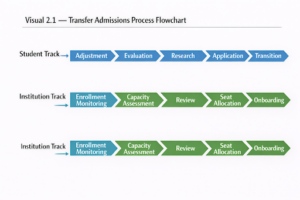
As you can see above, students and institutions are not operating on the same clock, and successful transfer planning requires aligning with the institutional timeline—not reacting to emotional milestones alone.
Transfer admissions are not mysterious—but they are structurally different from first-year admissions. They operate on:
- residual capacity
- staggered timelines
- major-level constraints
- post-admission evaluation that can materially alter outcomes
Before examining acceptance rates or institutional incentives, families need procedural clarity. Without it, even accurate data can be misread—and even successful transfer outcomes can carry hidden costs.
SECTION 3
The Data: Transfer Acceptance Patterns at Elite Private Universities

What the Numbers Actually Show—and How They’re Commonly Misread
Once families understand how transfer admissions function procedurally, the next question is inevitable: How competitive are transfer admissions, really?
The answer is often surprising—and frequently misunderstood.
At highly selective private universities, transfer admissions are neither a hidden back door nor a generous second chance. They are a capacity-driven process with extremely limited volume, governed by attrition patterns, major-level constraints, and short-term enrollment needs. Acceptance rates alone tell only part of the story. Seat availability tells the rest.
This section examines transfer selectivity at a small, coherent group of institutions where transfer myths are most persistent—and most costly.
3.1 Why This Analysis Focuses on a “Top 13” (US News & World Report 2025)
This paper intentionally focuses on a narrow group of highly selective private universities:
- Princeton University
- Massachusetts Institute of Technology
- Harvard University
- Stanford University
- Yale University
- California Institute of Technology
- Duke University
- Johns Hopkins University
- Northwestern University
- University of Pennsylvania
- Cornell University
- University of Chicago
- Brown University
- Columbia University
These institutions share several defining characteristics:
- They are private, national, and highly restrictive
- They operate without state-mandated transfer pipelines
- They enroll small transfer cohorts by design
- They publish consistent Common Data Set (CDS) reporting
Most importantly, these schools are where families most often assume that transfer represents a strategic workaround—an assumption the data does not support.
Public flagships and community-college pipeline schools behave differently and are addressed separately later in this paper. Mixing these systems would obscure, rather than clarify, how transfer selectivity actually works at the elite private level.
3.2 What Transfer Admit Rates Measure—and What They Don’t
A transfer admit rate is not a direct measure of generosity or accessibility. It is a snapshot of residual capacity in a given year.
According to compiled Common Data Set data, Ivy League transfer acceptance rates for fall 2024 ranged dramatically — for example, Harvard accepted fewer than 1% of transfer applicants, while Princeton and MIT admitted approximately 2.9% and 1.4% respectively.
At elite private universities, transfer admissions are shaped by three variables that fluctuate annually:
- Attrition after the first and second year
- Major-level retention, especially in capacity-managed programs
- Institutional priorities tied to enrollment stability
As a result, transfer admit rates can:
- rise without the process becoming “easier”
- fall even when applicant quality remains constant
- vary significantly year to year at the same institution
Equally important: the absolute number of transfer seats is extremely small, even when the admit rate appears comparable to Regular Decision.
By contrast, at some less selective public and regional institutions, transfer acceptance rates can be substantially higher (e.g., well over 50%), highlighting the institutional differences that families often overlook.
This distinction—between rate and volume—is where many families go wrong.
3.3 Regular Decision vs. Transfer: An Illustrative Comparison
To ground this discussion, Table 3.1 and Table 3.2 compare Regular Decision (RD) admit rates with transfer admit rates at the Top-13 institutions and Top Transfer institutions respectively, using the most recent Common Data Set reporting available.
Table 3.1 — Regular Decision vs. Transfer Admit Rates
Highly Selective Private Universities 2024-2025
| Institution & Rank | Approx. RD Admit Rate | Approx. Transfer Admit Rate | Notes |
| Princeton | ~4.4–4.6% | ~1.9–3.0% | Extremely limited seats; CDS shows small cohorts |
| MIT | ~4.8% | ~1.9–2.4% | Heavy STEM gating; very small cohort |
| Harvard | ~3.4% | ~0.7–1.0% | Very small transfer cohort |
| Stanford | ~3.9% | ~1.5–1.8% | Capacity-driven transfer |
| Yale | ~4.5% | ~1.4–1.6% | Transfer very limited |
| Caltech | ~3–4% | ~4% | Ultra-low volume |
| Duke | ~5.9–7% | ~4–5% | Competitive; major-level capacity |
| Johns Hopkins | ~7–8% | ~6.5% | Sequenced STEM programs |
| Northwestern | ~4.6–7% | ~13.0% | Quarter system effects on transcript |
| Penn | ~5.9–6% | ~5% | School-level gating |
| Cornell | ~7–8% | ~13.9% | College-level variation |
| UChicago | ~4.8–5% | ~6.5–9.3% | Small transfer intake |
| Brown | ~5.2–5.4% | ~5–5.9% | Open curriculum doesn’t imply open transfer |
| Columbia | ~4–4.9% | ~10–12% | GS program raises rate |
Important note: This table is intended to be interpretive, not predictive. Transfer outcomes depend far more on seat availability, major alignment, and credit applicability than on headline acceptance rates. This can vary widely from year to year.
Table 3.2 — Colleges with the Highest Transfer Acceptance Rates (2024–2025)
| Institution | Approx. RD Admit Rate | Approx. Transfer Admit Rate | Notes |
| Arizona State University | ~88–90% | 90.7% | Large public research university; open-access transfer mission |
| University of Houston | ~66–70% | 88.0% | Urban public university; strong regional pipelines |
| Michigan State University | ~83–88% | 77.9% | Land-grant flagship; capacity-driven intake |
| Florida International University | ~58–64% | 74.2% | Access-oriented public institution |
| Pennsylvania State University | ~50–55% | 69.8% | Flagship with multi-campus transfer pathways |
| University of Central Florida | ~41–45% | 67.4% | Very large public; extensive articulation agreements |
| University of Arizona | ~85–88% | 64.5% | Public flagship; broad access mission |
| Rutgers University–New Brunswick | ~65–68% | 57.6% | State university with structured in-state pipelines |
| University of South Florida | ~49–52% | 57.3% | Regional public with high transfer intake |
| University of California, San Diego | ~24–26% | 54.6% | Selective public; formal CA transfer pathways |
High transfer acceptance rates at large public universities reflect mission, scale, and policy design—not ease of entry into selective private institutions. Many of these universities operate under statewide articulation agreements, mandate transfer access as part of their public mission, and manage enrollment at far greater scale. These figures should not be compared directly to transfer admission rates at highly selective private universities, where transfer seats are limited, capacity-driven, and often junior-year only.
3.4 How These Tables Are Commonly Misread
Placed side by side, Tables 3.1 and 3.2 can appear to tell conflicting stories about transfer accessibility. At elite private universities, transfer admit rates often sit below—or only marginally above—Regular Decision rates, with absolute seat numbers that are vanishingly small. At large public universities, by contrast, transfer admit rates can exceed 50%, 70%, or even 90%. Without context, this contrast invites a misleading conclusion: that transfer is broadly “easier” than first-year admission, and that institutional selectivity softens after matriculation.
That conclusion is incorrect—not because the data are wrong, but because the systems they describe are fundamentally different.
The Top-13 institutions operate transfer admissions as a residual, capacity-driven process. Seats exist only when students leave, majors under-enroll, or cohort balance requires adjustment. Transfer cohorts are intentionally small, often junior-heavy, and constrained by major-level gating and credit applicability. Acceptance rates in this context reflect scarcity management, not openness. Even when a transfer admit rate appears higher than Regular Decision, the underlying math often involves dozens of seats—not thousands—and intense competition for highly specific academic profiles.
By contrast, the institutions in Table 3.2 are largely public universities with explicit access and transfer missions. Their high transfer acceptance rates are not a signal of lowered standards, but of policy design, scale, and infrastructure. Many operate under statewide articulation agreements, maintain guaranteed or priority transfer pathways, and manage enrollment at a scale that allows continuous intake without destabilizing degree progress. In these systems, transfer is not a workaround; it is a core feature of the educational pipeline.
Reading these tables together is essential—but only if they are not conflated. Table 3.1 explains why transfer at elite private universities is neither a back door nor a reliable second chance. Table 3.2 explains where transfer is structurally supported, predictable, and aligned with institutional mission. Confusing one system for the other is one of the most common—and costly—errors families make when evaluating transfer as a strategy.
Without guidance, families often draw the wrong conclusions from transfer statistics. Table 3.3 addresses the most common misinterpretations directly.
Table 3.3 — How to Interpret Transfer Admit Rates (Do / Don’t)
| Misinterpretation | Why It’s Incorrect | What to Look At Instead |
| “The transfer rate is higher than RD, so it’s easier” | Transfer seats are far fewer | Absolute number of seats |
| “Fewer applicants means better odds” | Capacity, not demand, is the bottleneck | Year-to-year seat volatility |
| “I’ll just transfer after one year” | Many schools favor junior transfers | Entry year patterns |
| “Admission solves the problem” | Major and credit approval come later | Time-to-degree math |
3.5 Why Volume Matters More Than Percentages
A Regular Decision cycle at a selective private university may involve thousands of admits. A transfer cycle may involve dozens.
That difference has consequences:
- Small changes in attrition can dramatically alter transfer rates
- A seemingly “reasonable” admit rate can mask an ultra-competitive seat market
- Transfer applicants are competing not against a cohort, but against each other for a handful of openings
The final number is visually small—often emphasized with scale contrast.
This visual reinforces the section’s central message: transfer admissions are governed by subtraction, not expansion.
At elite private universities, transfer admissions are not designed to absorb demand. They are designed to manage scarcity.
When families interpret transfer acceptance rates without accounting for seat volume, major gating, timing preferences, and post-admission evaluation, they risk making decisions that feel strategic but functionally extend time-to-degree, increase cost, and compound stress.
Understanding the math is not about discouraging transfer. It is about placing transfer in its proper strategic context—as a narrow, high-stakes option that must be weighed against alternatives with equal seriousness.
SECTION 4
Why Colleges Accept Transfers

Institutional Incentives, Capacity Logic, and Enrollment Reality
After examining transfer timelines and acceptance patterns, a reasonable question follows:
If transfer seats are so limited, why do colleges accept transfers at all?
The answer is neither altruistic nor punitive. It is structural.
Colleges do not admit transfer students because they are “more open” after the first year, nor because they want to correct perceived admissions mistakes. They admit transfers because enrollment is dynamic, and stability requires constant adjustment.
Understanding institutional incentives does not mean endorsing them. But it does allow families to make decisions grounded in how the system actually functions.
4.1 Where Transfer Seats Come From
Transfer seats do not appear because institutions decide to expand. They appear because something else has contracted.
At highly selective private universities, transfer capacity is created primarily through:
- Student attrition
- Students leave after the first or second year for academic, personal, financial, or health reasons.
- Even small attrition rates can create meaningful—but still limited—space.
- Leaves of absence and stopouts
- Students step away temporarily, often with the intent to return.
- These absences create short-term enrollment gaps that may or may not persist.
- Program-level churn
- Some majors retain students unevenly.
- Departments with high early attrition may need to backfill to sustain course offerings, faculty lines, or program viability.
The national data show sizable transfer mobility overall; combined upward, lateral, and returning transfers make up a significant share of undergraduate enrollment change, reinforcing that institutions constantly adjust enrollment rather than simply “accept more students.”
Importantly, these sources of capacity are reactive, not planned. Institutions rarely know with certainty how many transfer seats they will have until well into the academic year.
Table 4.1 — Primary Sources of Transfer Capacity
| Source | Why It Happens | How Predictable It Is |
| First-year attrition | Academic mismatch, personal reasons | Moderately predictable |
| Second-year attrition | Major lockout, transfer out | Less predictable |
| Leaves of absence | Health, family, finances | Low predictability |
| Program churn | Uneven major retention | Highly variable |
Transfer admissions are downstream of student movement, not upstream of institutional generosity.
4.2 Enrollment Stability, Not Expansion
Elite private universities are not trying to grow their undergraduate populations. In fact, many actively resist expansion due to constraints around:
- housing
- faculty-to-student ratios
- advising capacity
- classroom and lab space
Transfer admissions serve a different goal: maintaining equilibrium.
From an institutional perspective, admitting a small number of transfer students can:
- stabilize tuition revenue
- preserve course viability in key departments
- maintain planned class sizes across cohorts
This is why transfer admissions often:
- vary significantly year to year
- cluster around specific majors or schools within a university
- feel inconsistent from the outside
What families experience as unpredictability is often the byproduct of late-stage enrollment calibration.
4.3 Financial and Resource Considerations
Financial considerations play a role in transfer admissions—but not always in the way families expect.
At many private universities:
- transfer students may receive less institutional aid than first-year admits
- merit scholarships are often more limited
- financial aid budgets are allocated primarily during first-year cycles
This does not mean transfer students are unwelcome. It means they are often admitted under different financial assumptions.
From an institutional standpoint, transfer admissions can:
- offset lost tuition from attrition
- redistribute aid strategically
- preserve overall budget balance
For families, the implication is clear: transfer is rarely a cost-neutral move, even when tuition appears similar on paper.
4.4 Why Elite Privates Behave Differently Than Public Systems
It is important to distinguish elite private universities from public systems and flagships, which often operate under very different mandates.
Public universities may:
- be legally or politically incentivized to accept transfer students
- maintain formal articulation agreements with community colleges
- view transfer as a core access pathway rather than a residual one
Elite private universities, by contrast:
- are not obligated to expand access via transfer
- do not rely on transfer pipelines for mission fulfillment
- admit transfers primarily to maintain internal stability
This distinction explains why transfer outcomes at elite privates:
- are harder to predict
- are more sensitive to year-to-year shifts
- should not be generalized from public university models
Understanding this difference prevents families from importing expectations from one system into another—often with costly consequences.
4.5 The Strategic Implication for Families
Once institutional incentives are clear, a sobering but empowering truth emerges:
Transfer admissions are not designed to rescue students from disappointment.
They are designed to solve institutional capacity problems.
This does not mean transfer cannot be a good choice. It means it must be evaluated against:
- the institution’s needs, not just the student’s preferences
- program-level realities, not brand narratives
- financial and academic tradeoffs that extend beyond admission
Families who understand this are better positioned to:
- interpret acceptance rates accurately
- ask the right questions about majors and credits
- recognize when alternatives may offer better outcomes
Colleges accept transfer students not because they are more open after the first year, but because enrollment is fluid and stability requires adjustment.
Transfer seats exist when:
- students leave
- programs need balance
- capacity allows backfill
They disappear when those conditions change.
Understanding institutional incentives does not make transfer easier—but it makes the decision clearer. And clarity, in a system this complex, is a form of protection.
SECTION 5
Who Should Seriously Consider Transferring

Profiles, Preconditions, and the Difference Between Possibility and Fit
After understanding how transfer admissions work—and why institutions create transfer seats—the question becomes more personal:
When does transferring actually help a student move forward?
This section does not argue that transfer is rare or misguided. It argues that transfer is situational. It tends to work best for students whose challenges are structural, persistent, and unlikely to be resolved within their current institution—and who have the academic footing to absorb the transition.
The profiles below are not exhaustive, but they represent the most common scenarios in which transfer can be a rational, strategic move rather than a reactive one.
5.1 Academically Under-Challenged Students
Some students arrive at college well prepared—sometimes more prepared than their academic environment allows them to be.
Indicators that transfer might be worth considering:
- Consistently high performance paired with low intellectual engagement
- Limited access to advanced coursework, research, or mentorship
- A ceiling effect where effort is not matched by growth
This profile is often misunderstood. Being under-challenged is not about prestige; it is about trajectory. If a student is unable to deepen their academic work, build meaningful faculty relationships, or progress toward advanced goals within their current institution, transfer can offer access to a more demanding environment.
Critical caveat: Under-challenge must be demonstrated through performance and engagement—not inferred from brand comparison alone. Prestige dissatisfaction without evidence of unmet academic need is rarely a strong foundation for transfer success.
5.2 Academically Overstretched Students
At the other end of the spectrum are students whose academic preparation does not align with the pace or structure of their institution.
Indicators that transfer might be appropriate:
- Persistent academic distress despite tutoring and advising
- Grades that do not improve after the first semester adjustment period
- Escalating anxiety or burnout tied directly to academic load
In these cases, transfer can serve as a reset of academic environment, not of effort or accountability. A better-matched institution can allow a student to rebuild confidence, stabilize performance, and re-engage intellectually.
It’s important to note, however, that among community college students who transfer to four-year institutions, only about 32% achieve the transfer within six years, and fewer than half of those complete a bachelor’s degree, underscoring the stakes of mobility decisions.
Important distinction:
Short-term struggle is not the same as misfit. Many students experience a rocky first semester and recover strongly. Transfer becomes more viable when difficulty is sustained and structural rather than transitional.
5.3 Major Lock-Out Cases
Major access constraints are one of the most legitimate—and least emotional—reasons to consider transfer.
This profile typically includes students who:
- Were admitted to a university but not guaranteed entry into a desired major
- Discover that internal transfer policies are highly restrictive or capacity-based
- Face prerequisite sequencing that makes timely major entry unlikely
In fields such as computer science, engineering, business, and data science, being “in the university” is not the same as being “in the program.” When internal pathways are closed or prohibitively narrow, transfer may be the only viable way to pursue a chosen field.
Key requirement:
Students in this category must demonstrate preparation and commitment—through coursework, grades, and independent work—to justify a transfer based on major access.
5.4 Authentic Late Academic Pivots
Not all students begin college knowing exactly what they want to study. Some discover new academic interests only after exposure to college-level work.
Transfer can make sense when:
- The pivot is genuine and sustained, not reactionary
- The new interest is supported by coursework and performance
- The current institution cannot reasonably support the new direction
For example, a student who enters college intending to study pre-med but develops a strong interest in architecture, or one who shifts from humanities to applied STEM, may find that their current institution lacks the necessary programs or pathways.
What matters most:
Admissions committees look for evidence of evolution, not just explanation. A compelling pivot is one that is already underway, not merely proposed.
5.5 Disruption-Driven Cases
Sometimes, the reason to consider transfer has little to do with academics.
Circumstances such as the following can fundamentally alter what is feasible for a student:
- serious health issues
- family caregiving responsibilities
- geographic relocation
- financial disruption
In these cases, transfer may serve as a stabilizing intervention, allowing a student to continue their education under more realistic conditions. The strength of the transfer case rests not on ambition, but on clarity, responsibility, and forward planning.
Table 5.1 — Profiles Where Transfer Can Be Strategically Appropriate
| Profile | Core Issue | What Must Be True |
| Under-challenged | Academic ceiling | Strong performance + unmet opportunity |
| Overstretched | Sustained misfit | Support tried; distress persists |
| Major lock-out | Structural barrier | No viable internal pathway |
| Late pivot | Program mismatch | Evidence of new trajectory |
| Disruption-driven | Changed circumstances | Stable plan moving forward |
This table consolidates the narrative into patterns, reinforcing that transfer works best when the problem is structural, not emotional.
Importantly, recent outcome data complicate the assumption that transfer students are academically disadvantaged. Multiple analyses summarized by The Transfer Book and the National Student Clearinghouse suggest that students who transfer under aligned conditions—clear major pathways, minimal credit loss, and timely entry—often persist and graduate at rates comparable to, or in some cases exceeding, similarly prepared non-transfer peers.
These gains are not universal, and they are not automatic. They tend to appear when transfer is planned rather than improvised, and when institutional structures support continuity rather than reset. In other words, transfer success is less about movement itself and more about alignment between student readiness and institutional design—precisely the distinction this section aims to make.
5.6 Preconditions for a Successful Transfer
Across all profiles, several conditions tend to correlate with positive transfer outcomes:
- A clear diagnosis of what is not working
- Evidence that alternatives were explored, not ignored
- Academic performance that demonstrates readiness for transition
- A realistic understanding of credit, time, and cost implications
- Emotional maturity to navigate disruption without disengagement
Transfer is not simply a change of address. It is a disruption that demands resilience, planning, and clarity of purpose.
Readiness is not binary. Timing matters as much as justification.
Transfer can be a powerful tool—but only when used for the right reasons, at the right time, and with eyes open to the tradeoffs involved.
Students who benefit most from transferring are not those seeking escape, but those seeking alignment: between preparation and rigor, interest and access, life circumstances and feasibility.
In the next section, we examine the other side of this equation—who transfer is unlikely to help, and why restraint can sometimes be the wiser strategy.
SECTION 6
Who Probably Should Not Transfer

When Movement Adds Risk Instead of Resolution
After identifying the profiles for whom transfer can be strategically appropriate, it is equally important to name when transfer is unlikely to help—and may quietly make outcomes worse.
This section is not about judgment. It is about fit between problem and solution.
Transfer is a high-disruption intervention. When the root issue is not structural—or when the student lacks the conditions needed to absorb that disruption—transfer can delay graduation, increase cost, and deepen emotional strain without delivering the hoped-for benefits.
6.1 Prestige-Driven Transfers Without Academic Purpose
One of the most common—and most fragile—transfer motivations is prestige dissatisfaction.
This typically appears as:
- discomfort with the institution’s perceived status
- fixation on peers at more selective schools
- belief that brand alone will unlock better opportunities
What is missing in these cases is not ambition, but academic rationale.
Without a clear explanation of the following, transfer becomes an attempt to resolve identity anxiety through institutional affiliation.
- what academic or professional access is currently unavailable
- why that access is essential
- how the target institution uniquely provides it
Even when students achieve transfer outcomes, national research shows that many lose a substantial proportion of accumulated credits — on average over 40% of credits are not counted toward new degree requirements — which can amplify cost and time.
Why this rarely works:
Admissions committees are adept at detecting prestige-driven narratives. More importantly, even when admission is secured, the internal experience often remains unchanged. The underlying insecurity follows the student, while the academic and social disruption increases.
6.2 Students Thriving Academically but Uncomfortable Emotionally
Another frequent scenario involves students who are performing well academically but feel unsettled socially or emotionally.
Common signals include:
- strong grades paired with loneliness or dissatisfaction
- difficulty forming friendships in the first semester
- mismatch between expectations and lived experience
While these feelings are real, they are also common—particularly in the first year of college.
Transfer is often proposed as a way to escape discomfort. But discomfort is not the same as misfit.
In many cases, the more effective intervention is:
- intentional community-building
- counseling or coaching
- re-engagement with campus resource
- time
Key distinction:
Transfer may help when an environment is structurally incompatible. It rarely helps when the challenge is adjustment to independence, ambiguity, or new social norms.
6.3 Students Expecting a “Reset” of Academic Record
Some students approach transfer with the belief that it will erase earlier academic missteps.
This assumption is deeply misleading.
While GPA policies vary, several realities persist:
- transfer admissions decisions rely heavily on college performance, not high school records
- patterns of struggle often matter more than isolated grades
- academic habits do not reset automatically with a new campus
In addition, many institutions:
- accept credits without carrying over GPA
- enforce residency requirements that limit how much prior work counts
- expect immediate performance at the level of the new institution
Transfer can magnify—not mask—academic vulnerability.
6.4 Students Assuming Financial Aid Will Improve
Financial assumptions are one of the most dangerous blind spots in transfer planning.
Common beliefs include:
- “We’ll qualify for more aid after one year”
- “Transfer students get the same packages as first-years”
- “Merit aid will follow me”
In reality:
- institutional aid budgets are often allocated primarily to first-year cohorts
- merit awards are frequently more limited for transfers
- some need-based aid formulas become less favorable after a year of enrollment
Transfer is often a net financial loss, even when tuition appears similar on paper.
Families who proceed without a clear, written financial comparison risk discovering these constraints only after admission—when leverage is limited.
Table 6.1 — Common Misaligned Transfer Motivations
| Motivation | Why It’s Risky | What to Address Instead |
| Prestige anxiety | Lacks academic rationale | Clarify academic goals |
| Social discomfort | Often transitional | Community-building support |
| GPA reset hopes | Academics follow patterns | Skill and habit repair |
| Aid assumptions | Policies are restrictive | Full cost comparison |
This table serves as a diagnostic pause, encouraging families to reconsider whether transfer is being used to solve the right problem.
6.5 When Transfer Compounds Rather Than Resolves Risk
Across these profiles, a common theme emerges: transfer amplifies existing patterns.
- Students without clarity often feel more lost after transferring.
- Students without academic stability face steeper expectations.
- Students without emotional support experience greater isolation.
- Students without financial realism encounter new stressors.
None of this means students should remain where they are unhappy at all costs. It means that movement alone is not strategy.
In many cases, restraint—paired with targeted intervention—produces stronger outcomes than relocation.
Transfer is most effective when it addresses a structural mismatch that cannot be resolved internally. When it is used to escape discomfort, uncertainty, or comparison pressure, it often increases risk without improving outcomes.
Knowing when not to transfer is not a sign of settling. It is a sign of strategic maturity.
In the next section, we examine what transfer truly costs—financially, academically, and psychologically—so families can weigh decisions with full information rather than partial hope.
SECTION 7
The Hidden Costs of Transfer

Time, Money, Momentum, and Identity
By the time families reach this point in the conversation, most understand that transfer is competitive and capacity-driven.
What remains less visible—and often more consequential—are the costs that appear only after admission.
Rigorous research using administrative datasets suggests that the impact of transfer on long-term economic outcomes is not uniformly positive. Miller (2025) finds suggestive evidence of negative earnings returns for academically marginal students who transfer into flagship colleges, with mechanisms including substitution into lower-paying majors and reduced labor market experience following transfer.
These costs are not always deal-breakers. But they are real, cumulative, and unevenly distributed. Ignoring them does not make them disappear; it simply shifts their impact to a later stage, when choices are harder to reverse.
This section names those costs clearly.
7.1 Credit Loss and Delayed Graduation
The most immediate—and most underestimated—cost of transfer is credit loss.
A U.S. Government Accountability Office analysis found that students transferring institutions historically lost about 43% of their earned credits on average, depending on pathway — and even the best-aligned transfers can still lose meaningful coursework.
Credit loss does not always mean credits are rejected outright. More commonly, it takes subtler forms:
- credits accepted but not applied to the major
- credits counted only as electives
- sequencing gaps that delay entry into upper-division coursework
- residency requirements that cap transferable credits
The result is often the same: additional semesters.
Even a delay of one term can have cascading effects:
- increased tuition and fees
- additional housing costs
- postponed internships or research opportunities
- delayed entry into the workforce or graduate school
What makes credit loss particularly challenging is that it is often finalized after a student commits to transferring, when leverage is minimal and alternatives are limited.
Additional research shows that while community college transfers often begin with academic preparation similar to first-time students at four-year colleges, they nevertheless encounter structural hurdles: Monaghan and Attewell (2015) found that “students who do transfer have bachelor’s degree graduation rates equal to similar students who begin at four-year colleges,” but credit accumulation diverges after transfer, in part due to greater involvement in employment and stopping out of college — and credit loss itself significantly lowers bachelor’s completion odds.
Table 7.1 — Credit Loss → Time → Cost Matrix
| Credit Outcome | Typical Impact | Common Consequences |
| 0–6 credits lost | Minimal delay | Adjusted electives |
| 12–18 credits lost | 1 additional semester | Tuition + housing increase |
| 24+ credits lost | 1–2 additional years | Major restructuring; high cost |
This table anchors the abstract idea of “credit risk” in concrete timelines and financial implications.
7.2 Financial Costs Beyond Tuition
Families often compare institutions based on published tuition alone. Transfer exposes the limits of that comparison.
In practice, transfer-related financial costs may include:
- loss of merit scholarships that do not transfer
- reduced access to institutional aid pools
- additional semesters of enrollment
- duplicate fees (orientation, housing deposits, registration)
- relocation and transition expenses
Even when tuition appears similar, the total cost of attendance over time can diverge significantly.
It is not uncommon for a transfer that looks financially neutral in year one to become substantially more expensive by graduation—particularly if credit loss extends the academic timeline.
Research in transfer mobility suggests that only about 81.5% of students returned to their new institution for the next academic year after transferring, indicating that transfer continuity is real but not guaranteed.
7.3 Academic Disruption and Opportunity Cost
Transfer interrupts more than coursework. It disrupts academic momentum.
Academic performance patterns often reflect an initial adjustment period: national research finds that transfer students typically experience a temporary decline in GPA upon arrival at a four-year institution, followed by partial recovery — highlighting the transitional challenges inherent in transferring.
Key losses may include:
- relationships with faculty who know the student’s work
- continuity in research projects or labs
- eligibility for structured programs that require early entry
- leadership pathways tied to cohort progression
Arriving midstream can place transfer students at a disadvantage in environments where opportunities are built sequentially. While many students recover and thrive, doing so requires additional effort, confidence, and institutional navigation skills.
This opportunity cost is rarely visible in admissions conversations—but it shapes outcomes long after.
7.4 Social and Identity Costs
The most personal costs of transfer are often the least discussed.
Transfer requires students to:
- leave behind a partially formed identity
- re-enter a social environment where groups are already established
- explain their story—sometimes repeatedly—to peers and faculty
For students already questioning their belonging, this can intensify feelings of isolation. For students who carry a narrative of “failure” into the transfer process, the emotional burden can follow them into the new environment.
It is important to say this clearly: Transfer is not a moral failure—but it can feel like one if the story is not reframed intentionally.
Without support, students may internalize disruption as personal inadequacy rather than situational recalibration.
Table 7.2 — Non-Financial Costs of Transfer
| Dimension | Potential Impact |
| Academic identity | Loss of continuity and confidence |
| Mentorship | Restarting faculty relationships |
| Leadership | Fewer opportunities to lead midstream |
| Belonging | Social disruption and isolation |
| Narrative | “I failed” vs. “I recalibrated” |
This table legitimizes emotional and identity costs as real variables, not secondary concerns.
7.5 Why These Costs Are Often Minimized
Transfer is frequently framed as a clean move: leave one place, arrive at another, start fresh. That framing is comforting—but inaccurate.
These costs are minimized because:
- admissions conversations focus on entry, not completion
- institutions do not bear the long-term cost of extended timelines
- families underestimate the compounding effect of small delays
- students are motivated to believe disruption will be brief
It is equally important to note that these costs are not evenly distributed. Emerging research suggests that when transfer pathways are well-articulated—particularly between institutions with aligned curricula—credit loss and time-to-degree penalties are significantly reduced. In these cases, transfer can function less as disruption and more as redirection.
The challenge is that students are rarely told in advance which category they fall into. The same transfer decision can produce radically different outcomes depending on institutional policy, major structure, and timing. This variability—not the act of transferring itself—is what makes uninformed transfer decisions so costly.
Recognizing these dynamics does not mean rejecting transfer. It means approaching it with eyes open.
Too often, the real cost of transfer is cumulative, not singular.
Transfer decisions are often made with a narrow lens: Can I get in?
But the more consequential questions are:
- Will my credits count?
- Will I graduate on time?
- What opportunities will I lose—and what might I gain?
- Am I prepared for the emotional reset this requires?
When these questions are ignored, transfer can quietly extend timelines, increase cost, and amplify stress. When they are addressed honestly, transfer—if chosen—can be navigated with far greater resilience and success.
In the next section, we turn from cost to strategy: what actually makes a transfer application compelling when transfer is the right choice.
SECTION 8
What Makes a Strong Transfer Application

Signals, Narrative Coherence, and Why “Wanting Out” Is Not Enough
When transfer is the right strategic choice, the next question families ask is often tactical: What do admissions committees want to see?
The answer is not a checklist—and it is rarely about dissatisfaction alone.
Strong transfer applications succeed because they demonstrate coherence: between past performance, present decision-making, and future plans. They show growth without defensiveness, ambition without entitlement, and clarity without complaint.
Empirical evidence indicates that transfer students are not inherently less capable academically. For example, comparative research at a large university found that transfer students often achieve equal or higher GPAs compared with non-transfer peers, undermining the stereotype that transfer students are academically inferior.
This section explains the signals that matter most in transfer review—and the narrative structures that support them.
8.1 The Signals Transfer Committees Actually Evaluate
Transfer admissions committees operate with less information than first-year committees—and higher stakes. They are admitting students into a system already in motion. As a result, they prioritize predictability and readiness.
According to national admissions advisory reporting, transfer acceptance rates at many selective institutions are equal to or lower than first-year rates, reflecting the premium placed on demonstrated academic readiness and fit, not simple dissatisfaction.
Across institutions, several signals consistently rise to the top:
- Upward or stable academic trajectory
Committees care less about a single imperfect grade and more about patterns:- Is performance improving?
- Are challenges addressed proactively?
- Does the transcript reflect increasing rigor?
- Evidence of academic seriousness
This includes:- course selection aligned with stated interests
- engagement beyond minimum requirements
- thoughtful use of office hours, labs, or discussion sections
- A mature, specific reason for leaving
“It wasn’t the right fit” is not sufficient on its own. Strong applications articulate:- what is structurally unavailable at the current institution
- why that gap matters academically or professionally
- Demonstrated resilience and agency
Committees look for students who responded to difficulty by:- seeking support
- adjusting strategies
- making informed decisions—not retreating
- A credible plan for the target institution
Transfer is not about escape; it is about entry. Applicants must show they understand:- the academic structure of the destination
- how they will integrate into it immediately
Table 8.1 — Signals Admissions Committees Prioritize in Transfer Review
| Signal | What Committees Look For |
| Academic trajectory | Stability or improvement |
| Engagement | Evidence beyond grades |
| Rationale | Structural, not emotional |
| Resilience | Action in response to challenge |
| Planning | Clear use of target resources |
This table reframes strength as alignment, not perfection.
8.2 The Role of Recommendations: Why Professors Matter
Transfer applications often require—or strongly prefer—letters from college faculty rather than high school teachers.
This shift reflects a core question in transfer review:
Can this student perform and integrate at our institution right now?
Faculty recommendations offer insight into:
- classroom performance relative to peers
- intellectual curiosity and follow-through
- readiness for upper-division work
- professionalism and accountability
Because these relationships take time to build, successful transfer applicants typically:
- engage early in the term
- attend office hours consistently
- contribute meaningfully in class
- communicate transparently about goals when appropriate
This requirement alone makes impulsive transfer planning risky. Without faculty advocates, even strong students may struggle to present a credible case.
8.3 The Transfer Narrative: Leaving Without Burning Bridges
The heart of a transfer application is not the résumé. It is the explanation.
Strong transfer narratives share a common architecture:
- they acknowledge what was
- they explain what changed
- they articulate what comes next
What they avoid is blame.
Table 8.2 — Transfer Narrative Architecture
| Phase | Purpose | Guiding Question |
| Past | Context | What did I expect and experience? |
| Present | Diagnosis | What is no longer working—and why? |
| Future | Direction | How will this institution enable my next step? |
The most persuasive narratives frame transfer as a continuation of growth, not a repudiation of the past.
8.4 Common Narrative Pitfalls to Avoid
Even academically strong applicants can weaken their case through avoidable missteps.
Common pitfalls include:
- Over-indexing on dissatisfaction
Focusing on what feels wrong without explaining what is academically missing. - Blame-shifting
Positioning the institution, faculty, or peers as obstacles rather than acknowledging agency. - Prestige signaling without substance
Referencing rankings or reputation without program-specific rationale. - Hypothetical futures
Describing what might be done rather than what is already underway.
Transfer committees are not unsympathetic—but they are discerning. They want students who understand the cost of moving and have thought carefully about why it is worth it.
8.5 Coherence Is the Core Criterion
When transfer applications succeed, it is rarely because they are dramatic or eloquent. It is because they make sense.
- The transcript supports the stated direction.
- The recommendations reinforce the narrative.
- The target institution is not interchangeable with others.
In short, the application answers the implicit question:
Why this student, at this moment, in this place?
Strength in transfer applications comes from alignment, not aspiration alone.
Strong transfer applications are not arguments for escape. They are demonstrations of readiness.
They show that a student:
- understands what is not working
- has taken responsibility for addressing it
- knows precisely how the next institution fits into a larger academic trajectory
When transfer is chosen deliberately—and presented coherently—it can open doors. When it is framed as a reaction to disappointment, those same doors often remain closed.
In the next section, we step back from applications entirely and ask a more fundamental question: Is transfer the best solution at all—or are there alternatives that achieve the same goals with fewer costs?
SECTION 9
Transfer vs. Alternatives
A Decision Framework for Solving the Right Problem
By the time families consider transfer seriously, it often feels like the only remaining option. But that perception is usually shaped by urgency rather than analysis.
Transfer students represent just over 13% of continuing undergraduates nationally, while the majority of students remain in place and find internal academic or career pathways, underscoring that transfer is one among many modes of progress.
This section reframes transfer as one strategy among several—and often not the lowest-risk one.
The central question is not “Can I transfer?” but rather:
“What outcome am I trying to achieve—and what is the most efficient way to achieve it?”
9.1 The Most Common Goals Behind Transfer Interest
Across hundreds of advising conversations, transfer interest tends to cluster around a small number of underlying goals:
- access to a specific major or academic pathway
- stronger academic rigor or mentorship
- improved career or internship pipelines
- geographic or personal feasibility
- psychological relief from a sense of misalignment
Transfer may address some of these goals—but it is rarely the only option.
9.2 Internal Solutions Families Often Overlook
Before leaving an institution, students should exhaust internal mechanisms that may resolve the issue with far less disruption.
These can include:
- internal transfer or major petitions, even when competitive
- double majors, minors, or certificates that create functional access
- honors programs or departmental distinctions entered in Year 2
- direct faculty mentorship, research, or independent study
- cross-registration with nearby institutions
These pathways often require persistence and advocacy—but they preserve:
- accumulated credits
- faculty relationships
- leadership trajectories
- financial stability
9.3 Strategic External Alternatives That Are Not Transfer
When internal solutions are insufficient, some goals can be achieved through external but non-transfer strategies.
Examples include:
- structured internships that realign professional trajectory
- research programs or summer intensives that deepen specialization
- gap semesters or years (rare, but sometimes stabilizing)
- planned graduate or professional pathways that shift timing, not location
These options can reposition a student’s profile without resetting their undergraduate timeline.
Table 9.1 — Transfer vs. Alternative Solutions
| Goal | Transfer | Alternative Option |
| Major access | Possible, high risk | Internal pathways, certificates |
| Academic rigor | Possible | Honors, research, faculty mentorship |
| Career pipelines | Possible | Targeted internships |
| Geography | Possible | Temporary relocation, remote options |
| Emotional relief | Temporary | Support, time, reframing |
Most transfer goals have multiple possible solutions—and some carry far lower cost.
9.4 When Transfer Becomes the Best Option
After alternatives are considered honestly, transfer may still emerge as the most appropriate path.
This typically occurs when:
- internal access is structurally blocked
- academic trajectory cannot advance meaningfully
- life circumstances have changed irreversibly
- the student has the academic and emotional readiness to transition
At this point, transfer is no longer reactive. It is chosen with full awareness of tradeoffs.
Transfer is a powerful tool—but it is also a blunt one.
Before using it, families owe themselves a careful evaluation of:
- what they are trying to change
- which changes require relocation
- which can be achieved with less disruption
When alternatives are explored seriously, transfer decisions—when made—are clearer, calmer, and more successful.
SECTION 10
Action Checklists for Families
From Panic to Plan
Analysis without action leaves families informed but still stuck. This final section translates insight into structured next steps, designed to stabilize decision-making during the most emotionally charged months of the year.
These checklists are not meant to rush decisions. They are meant to slow them down intelligently.
10.1 January Stabilization Checklist
Before discussing transfer at all, families should focus on stabilization.
Table 10.1 — January Stabilization Checklist
| Action | Purpose |
| Review first-semester performance | Separate signal from noise |
| Meet with academic advisor | Clarify internal options |
| Identify stress vs. structural issues | Avoid misdiagnosis |
| Pause comparison behaviors | Reduce reactive decision-making |
| Set a reassessment timeline | Restore a sense of control |
This checklist acknowledges that January decisions are often made under emotional pressure—and builds space for clarity.
10.2 Transfer Feasibility Checklist
If transfer remains under consideration, feasibility must be evaluated before applications are submitted.
Table 10.2 — Transfer Feasibility Checklist
| Question | Why It Matters |
| Will my credits count toward the major? | Graduation timing |
| What is the typical entry year? | Seat alignment |
| Is faculty support available for recommendations? | Application strength |
| What is the realistic financial picture? | Cost containment |
| What alternatives have I ruled out—and why? | Decision integrity |
This checklist ensures that families evaluate post-admission realities, not just acceptance odds.
10.3 Application Readiness Checklist
Only after stabilization and feasibility should application readiness be assessed.
Table 10.3 — Application Readiness Checklist
| Element | Ready? |
| Clear, non-defensive narrative | ☐ |
| Academic record supports rationale | ☐ |
| Faculty recommendations secured | ☐ |
| Target institutions researched deeply | ☐ |
| Contingency plan in place | ☐ |
This checklist reframes readiness as coherence, not urgency.
The goal of this paper has never been to push families toward or away from transfer. It has been to replace fear with structure.
When families:
- diagnose before deciding
- evaluate alternatives honestly
- model costs realistically
- act deliberately rather than reactively
transfer—if chosen—becomes a strategy rather than a reflex.
CONCLUSION
Strategy, Not Panic
Transfer is often framed as a moment of rescue—a way to correct a misstep, reclaim momentum, or restore confidence after disappointment. But as this paper has shown, transfer is not a shortcut, a reset, or a neutral move. It is a high-impact strategic decision, shaped as much by institutional capacity and structural constraints as by student ambition.
When transfer works, it is not because a student found an easier path. It is because they understood the system clearly, diagnosed the problem accurately, and chose movement deliberately—eyes open to cost, timing, and tradeoffs.
Just as importantly, this paper has argued that not transferring can also be a strategic choice. Many students thrive by staying put and reengineering their experience: through internal pathways, deeper mentorship, alternative credentials, or time. These options are less visible than transfer—but often more efficient, less disruptive, and better aligned with long-term outcomes.
The data also point to a more hopeful reality: transfer outcomes are improving in many sectors of higher education, particularly where institutions have invested in transparency, advising, and credit alignment. The future of transfer is not inherently bleak—but it is uneven. Students who understand the system are better positioned to benefit from its evolution, rather than be harmed by its blind spots.
For families navigating this decision, the most important shift is philosophical:
- From urgency to analysis
- From comparison to clarity
- From reaction to strategy
Discomfort, disappointment, and doubt are not evidence of failure. They are signals. The task is not to escape them as quickly as possible, but to interpret them correctly.
Transfer deserves a place in the strategic toolkit. But it should never be the first tool reached for in a moment of panic. When used well, transfer reflects maturity, planning, and agency. When used reflexively, it often compounds the very challenges it is meant to resolve.
The most successful students are not those who move the fastest—but those who choose their direction with intention.
In a system this complex, slowing down is not hesitation. It is strategy.
References
BestColleges. (2024, October 31). Data shows growth in transfer students.
https://www.bestcolleges.com/news/data-shows-growth-in-transfer-students/
BestColleges. (2024). Transfer acceptance rates: How hard is it to transfer colleges?
https://www.bestcolleges.com/research/transfer-acceptance-rates/
Community College Daily. (2024, February). A good sign: Transfer rates are up. https://www.ccdaily.com/2024/02/a-good-sign-transfer-rates-are-up/
Government Accountability Office. (2017). Higher education: Students need more information to help reduce challenges in transferring college credits (GAO-17-574).
https://www.gao.gov/products/gao-17-574
Inside Higher Ed. (2024, February 28). New report shows transfers rising among disadvantaged groups.https://www.insidehighered.com/news/students/academics/2024/02/28/new-report-shows-transfers-rising-among-disadvantaged-groups
Hossler, D., Shapiro, D., Dundar, A., et al. (2012). Transfer and mobility: A national view of pre-degree student movement in postsecondary institutions (Signature Report No. 2). National Student Clearinghouse Research Center.
Inside Higher Ed. (2015, July 8). More than a third of college students transfer.
https://www.insidehighered.com/quicktakes/2015/07/08/more-third-college-students-transfer
Inside Higher Ed. (2025, September 5). Transfer data show little progress for first-time students.
https://www.insidehighered.com/news/quick-takes/2025/09/05/transfer-data-shows-little-progress-first-time-students
Monaghan, D. B., & Attewell, P. (2015). The community college route to the bachelor’s degree. Educational Evaluation and Policy Analysis, 37(1), 70–91. https://doi.org/10.3102/0162373714521865
National Student Clearinghouse Research Center. (2024). Transfer enrollment and pathways.
https://nscresearchcenter.org/category/transfers/
National Student Clearinghouse Research Center. (2024). College transfer enrollment grew by 4.4% in fall 2024.
https://www.studentclearinghouse.org/nscblog/college-transfer-enrollment-grew-by-4-4-in-the-fall-of-2024/
National Student Clearinghouse Research Center. (2024). Tracking transfer report reveals student pathway insights. https://www.studentclearinghouse.org/nscblog/tracking-transfer-report-reveals-student-pathway-insights/
National Student Clearinghouse Research Center. (2024). Returning learners lead transfer population growth.
https://www.studentclearinghouse.org/nscblog/data-dive-returning-learners-lead-transfer-pop/
Shapiro, D., Dundar, A., & Ziskin, M., et al. (2013). Baccalaureate attainment: A national view of the postsecondary outcomes of students who transfer from two-year to four-year institutions (Signature Report No. 5). National Student Clearinghouse Research Center.
Stewart, D. L. (2012). Academic achievement and the transfer student: A comparative analysis. Journal of College Student Retention: Research, Theory & Practice, 14(1), 123–144.
Taylor, B. J., & Jain, D. (2017). The transfer function in American higher education: A review of scholarship and research. Community College Review, 45(3), 195–218.
The Transfer Book. (2024). College transfer acceptance rates.
https://thetransferbook.com/stats/
The Transfer Book. (2024). Good news for transfer students: Recent data shows rising transfer success.https://thetransferbook.com/good-news-for-transfer-students-recent-data-shows-rising-transfer-success/
U.S. News & World Report. (2024). Colleges with the lowest acceptance rates.
https://www.usnews.com/best-colleges/rankings/lowest-acceptance-rate
Xu, D., Jaggars, S. S., Fletcher, J., & Fink, J. (2018). Are community college transfer students “a good bet” for 4-year admissions? Comparing academic and labor-market outcomes between transfer and native 4-year college students. The Journal of Higher Education, 89(4), 478–502. https://doi.org/10.1080/00221546.2018.1434280
Xu, D., & Roksa, J. (2020). Strategic or scattershot? Examining transfer patterns from community colleges. Journal of Higher Education, 91(4), 477–505.
Xu, D., & Roksa, J. (2025). Transfer pathways and postsecondary outcomes (EdWorkingPaper No. AI25-1159). Annenberg Institute at Brown University. https://edworkingpapers.com/sites/default/files/ai25-1159.pdf