
Why Objective Academic Evidence Matters Again
By Lindsey Kundel, Editor in Chief
Image Credit: Pablo Merchán Montes, For Unsplash+
Introduction
Every year, admissions offices remind us that they’re looking at the “whole student.” And that’s true—up to a point. But 2025 has marked a sharp shift back toward what I’d call objective academic evidence: standardized test scores, externally graded work, AP and IB exams, and other measurable indicators of readiness.
Why now? Because too many of the softer pieces of a college application—essays, recommendation letters, even resumes—are harder than ever to evaluate with confidence. Add the FAFSA fiasco of 2024, which scrambled yield models and financial aid distribution, and the result is predictable: colleges are looking for signals they can trust. Families need to understand why this reset is happening, what the data says about who’s applying and where, and how to plan accordingly.
1. Testing Is Back—And It’s About Trust

After nearly five years of test-optional momentum, the pendulum has swung the other way. Harvard, Dartmouth, Brown, Caltech, Georgetown, and UT Austin now require test scores again. Yale has adopted a “test-flexible” policy that allows AP or IB scores in lieu of SAT/ACT. According to the Washington Post, many of the most selective schools are now openly saying that testing is essential for fair comparison.
The Common App data tells the story: for the first time since the pandemic, test score reporting rose 11% in 2025. That’s not just a statistical blip. It reflects families leaning back into testing, sensing its renewed weight.
“Test scores have continued to predict academic performance in Yale College … and test scores are the single greatest predictor of a student’s performance in Yale courses in every model we have constructed.” — Jeremiah Quinlan, Dean of Undergraduate Admissions & Financial Aid, Yale University (Feb. 22, 2024).
Why is testing back? There are three main reasons:
- Predictive power. As Harvard noted in its announcement, test scores remain among the best predictors of first-year academic performance when paired with GPA. Without them, admissions officers struggled to fairly compare students from vastly different high schools.
- Equity in context. Paradoxically, testing can help level the playing field. A 1450 SAT score from a rural high school that rarely sends students to selective colleges may carry more weight than straight A’s alone. Dartmouth pointed out that scores help uncover hidden talent outside the prep school pipeline.
- Trust in a skeptical age. With AI-assisted essays, consultant-polished applications, and grade inflation making it harder to discern authenticity, colleges want something they can verify. A digital, proctored SAT isn’t perfect—but it’s comparable across applicants in a way an essay simply isn’t.
Testing Policies at Selective Schools (2025)
| Institution | 2025 Testing Policy | Notes |
| Harvard | Required | Announced 2024 return for Class of 2029 |
| Dartmouth | Required | “Predictive value” cited |
| Brown | Required | Reinstated 2024 |
| Yale | Test-flexible | SAT/ACT or AP/IB accepted |
| Caltech | Required | Ends pandemic moratorium |
| UT Austin | Required | Applies to Fall 2025 entrants |
| Georgetown | Always required | Policy unchanged |
To put it simply: testing is back because it offers colleges a piece of the puzzle they can still believe.
All of this loops back to the same idea: colleges want proof—scores and subject exams they can compare across wildly different high schools.
2. FAFSA’s Shockwave Is Still Reverberating
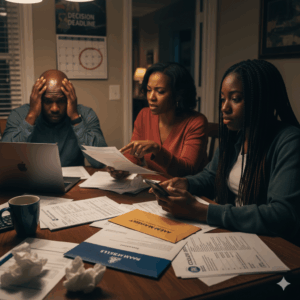
If testing is about trust, FAFSA has been about chaos. The 2024 rollout of the new FAFSA was riddled with technical failures and delays. The Government Accountability Office reported a 9% drop in first-time FAFSA filers—about 432,000 fewer students seeking aid. A Lumina/Gallup poll found that 25% of applicants had trouble even submitting the form, and 31% of families said the delays directly affected their enrollment choices.
Private colleges felt the pain too. A NAICU survey revealed that nearly half of private institutions struggled to fill their 2024 classes because financial aid information came too late. State systems scrambled: California extended its Cal Grant deadline after applications dropped by 25%.
The numbers have started to rebound—the Class of 2025 FAFSA completion rate climbed back to 53.9%, near pre-pandemic levels—but the damage to trust lingers. As one NASFAA panel put it: “The starting line was delayed, but the school year’s start date wasn’t.” Families had to make life-changing decisions without reliable aid data.
And here’s the key connection: when yield models are shaken by aid uncertainty, colleges double down on what they can measure reliably. FAFSA chaos has indirectly strengthened the case for test scores, AP/IB results, and other quantifiable evidence.

FAFSA Filing Chaos (2024–25)
| 2024–25 FAFSA Cycle | Source |
| −9% drop in first-time FAFSA filers (~432,000 fewer) | GAO Blog |
| 25% of applicants had trouble submitting FAFSA | Axios, Lumina/Gallup |
| <50% FAFSA completion (Class of 2024) | Axios, Lumina/Gallup |
| 31% said FAFSA delays hurt enrollment choice | Axios, Lumina/Gallup |
| 9% of private colleges struggled to fill classes | NAICU |
| 25% drop in Cal Grant applications (CA) | SF Chronicle |
Tuition Trends (2024–25)
Tuition isn’t spiking—uncertainty is. The College Board’s 2024–25 figures show modest year-over-year increases: about +2.5% at public two-year colleges, +2.7% for in-state public four-years, and +3.9% at private nonprofit four-years. Importantly, once you adjust for ~3.1% inflation, public-sector published tuition and fees actually declined in real terms. Families don’t feel that, though—because they plan around sticker price and won’t see their net price until aid lands. That timing gap matters in a post-FAFSA-fiasco world.
Budgets still bite. Even with relatively tame tuition growth, the all-in student budgets (tuition + fees + room/board + transport, etc.) remain hefty: an average of $29,910 for in-state students at public four-years, $49,080 for out-of-state at publics, and $62,990 at private nonprofits in 2024–25. Housing and food do a lot of the damage; they are the elastic pieces that pushed families into uncomfortable guesswork when FAFSA ran late.
Net price helps—but opacity hurts. After grants and scholarships, the average net cost of attendance (not just tuition) in 2024–25 was about $20,780 at public four-years and $36,150 at private nonprofits—meaning the typical student pays far less than sticker. Yet until aid packages arrive, families can’t plan around those numbers with confidence. That’s why the FAFSA delays didn’t just frustrate people; they froze decisions. Colleges, unsure of yield, leaned more heavily on inputs they could evaluate early and compare fairly—test/AP/IB results—long before aid finalized.
The longer arc: College Board researchers also note that, inflation-adjusted, published tuition and fees are lower in 2024–25 than in 2019–20 across all three sectors, helped by state support and tuition freezes. That’s good macro news, but it doesn’t erase household-level anxiety when award letters arrive late or change. Again, this cycle rewarded applicants who paired strong academic signals with on-time, accurate aid filings.
| Sector | 2024–25 Change | Source |
| Public 2-year (in-district) — published tuition & fees | +2.5% | College Board Newsroom |
| Public 4-year (in-state) — published tuition & fees | +2.7% | College Board Newsroom |
| Private nonprofit 4-year — published tuition & fees | +3.9% | College Board Newsroom |
| Inflation-adjusted published tuition & fees vs. 2019–20 | Lower in 2024–25 (all 3 sectors) | Inside Higher Ed |
| Avg student budget (COA) — public 4-yr in-state | $29,910 | College Board Newsroom |
| Avg student budget (COA) — public 4-yr out-of-state | $49,080 | College Board Newsroom |
| Avg student budget (COA) — private nonprofit 4-yr | $62,990 | College Board Newsroom |
| Avg net cost of attendance — public 4-yr | $20,780 | Bipartisan Policy Center |
| Avg net cost of attendance — private nonprofit 4-yr | $36,150 | Bipartisan Policy Center |
When price clarity slipped, proof stepped in—scores/AP/IB gave admissions a firmer footing while aid data lagged.
3. What the Common App Data Really Shows
Even amid FAFSA disruption, application volume is surging. By March 2025, the Common App reported:
- Applicants up 5% to ~1.5 million.
- Applications increased by 6%, with more students applying to multiple schools.
- Latino applicants increased by 15%; Black applicants increased by 12%.
- First-generation applicants up 13%.
- Fee waiver–eligible students up 9%.
- Applications to public universities up 10%, compared to 3% for private institutions.
By cycle’s end, first-gen students numbered nearly 600,000 applicants, according to Inside Higher Ed.
And the regional story is even more striking. Texas saw a 72% surge in first-gen applicants, fueled by a combination of state-level supports: free application weeks, a direct admissions dashboard, dual-credit programs, and expanded tuition-free pledges.
This data tells two stories at once. On the one hand, access is expanding, and that’s a positive trend. On the other, the pressure is increasing—more applications, more competition, more selective admissions at the schools gaining momentum. Public universities, in particular, are carrying the load of first-gen and low-income growth. That’s a real equity challenge, and one that families should be aware of when choosing where to apply.
Common App Growth by Demographics (2024–25)
| Demographic / Category | Growth Rate | Notes |
| Total first-year applicants | +5% (~1.5M) | Record high |
| Applications submitted | +6% (~10M) | More apps per student |
| Latino applicants | +15% | Largest demographic growth |
| Black applicants | +12% | Second-largest increase |
| First-gen applicants | +13% (~600K) | Historic high |
| Fee-waiver eligible | +9% | Strong low-income growth |
| Applications to publics | +10% | Outpacing privates |
| Applications to privates | +3% | Slower growth |
Bigger pools raise the premium on proof—comparable signals that help sort at scale.
4. The Regional Realignment
Prestige is no longer confined to the Ivy corridor. Southern and Southwestern universities are rising in both applications and selectivity. Auburn, Clemson, Rice, and Emory are increasingly attractive alternatives for students in the Northeast who feel priced out of Ivies or burned by FAFSA delays.
The UC system is also revealing where growth is happening. While overall UC applications dipped slightly in 2025 (-0.5%), UC Merced saw a 44.9% increase and UC Riverside 17.9%. These surges show how regional flagships are diversifying and becoming more competitive in their own right.
Some skeptics argue this Southern and regional growth won’t last, pointing to demographic declines ahead. But right now, the data shows a clear recalibration of where selectivity and prestige are consolidating. Families who still build lists solely around Northeastern schools are missing the broader picture.
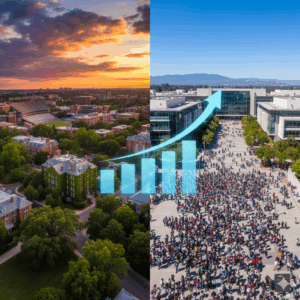
Regional Shifts within the UC System
According to Reporting by the San Francisco Chronicle
| UC Campus | Application Change (%) | In-State Admit Change (%) | Notes |
| UC Merced | +44.9% applications | +71.9% admits | Largest jumps in both applications and admits |
| UC Riverside | +17.9% applications | +46% in-state admits | Major growth among CA applicants |
| UC Davis | +4.2% applications | +10.4% first-year admits | Moderate growth in prestige campus |
| UC Santa Cruz | –7.2% applications | (Not specified) | Application decline despite system-wide growth |
| UC Berkeley | (Not specified) | –8% in-state admits | Fewer CA admits to elite campus |
| UCLA | (Not specified) | –2.4% in-state admits | Slight decline in CA share |
| UC San Diego | (Not specified) | (Broadly reduced CA admits; no % given) | Premium campus with modest pullback |
| UC Irvine | (Not specified) | (Reduced CA share; no % given) | Selective, pulled back in-state admits |
| UC Santa Barbara | (Not specified) | (Reduced CA share; no % given) | Admissions pulled back modestly |
| UC System Overall | –0.5% applications | +7.4% in-state CA admits; system admit rate up to 77% for CA, 73% overall | System-wide flat application volume, but more admits |
Prestige is shifting geographically, but the mechanism remains the same: objective evidence lets colleges sort through growing applicant pools with greater confidence.
5. What Counts as “Objective Academic Evidence”?
I’ve been using this phrase because I think it captures what colleges are asking for—but let me be clear. By “objective academic evidence,” I mean:
- Standardized tests (SAT, ACT, AP, IB, A-Levels, etc.)
- Externally graded or verified work (dual-enrollment courses, published research, science fair awards, Olympiad results)
- Credentials that can be benchmarked across contexts (certifications, competitions, proctored exams)
What doesn’t fit? Essays polished with AI. Recommendation letters written with heavy coaching. Extracurricular lists inflated by consulting firms. Colleges know these elements have value, but they also know they’re increasingly susceptible to spin.
In 2025, the competitive edge comes from giving admissions officers something they don’t have to guess about.
6. What This Means for Families
So what’s the practical advice for students applying this fall?
- Plan to test. Even at test-optional schools, a strong score is an asset.
- File FAFSA early and carefully. Don’t rely on extensions; assume glitches and build a buffer.
- Watch regional trends. If you’re in the South or Southwest, know that competition is rising; in California, consider how surging campuses like Merced may fit your strategy.
- Build proof, not polish. Highlight research you’ve completed under faculty supervision, competitions you’ve entered, or external credentials.
The admissions process has always been about balancing story and substance. In 2025, substance is winning.
Conclusion
The throughline in all of this is simple: colleges want proof. Testing is back because it’s verifiable. FAFSA’s collapse pushed schools toward more stable inputs. Application surges are rewarding institutions that can handle the volume with objective criteria.
Families should take note. This isn’t the end of essays, narratives, or personal stories—but those softer elements will matter less unless they’re paired with academic signals that colleges can trust.
2025 is the year admissions said, “Don’t just tell us. Show us.”
References
Testing Comeback
- Washington Post (July 31, 2025) — “College applications open Friday. Here’s what to know.” Coverage of reinstated testing policies at Ivy League, Georgetown, Caltech, UT Austin; digital SAT and ACT changes.
https://www.washingtonpost.com/education/2025/07/31/college-applications-what-to-know/ - Collegedata (2025) — “6 College Admissions Trends to Watch in 2025.” Noted 11% rise in test-score reporting.
https://www.collegedata.com/resources/getting-in/6-college-admissions-trends-to-watch-in-2025 - Education Week (August 2025) — “The Changing Face of College Applications, by the Numbers.” Includes quote from IvyWise’s Amy Kirkcaldy.
https://www.edweek.org/teaching-learning/the-changing-face-of-college-applications-by-the-numbers/2025/08 - Harvard Gazette (April 11, 2024) — “Harvard announces return to required testing.” Quotes from Hopi Hoekstra & William Fitzsimmons on predictive value of SAT/ACT.
https://news.harvard.edu/gazette/story/2024/04/harvard-announces-return-to-required-testing/ - Yale News (Feb. 22, 2024) — “Yale announces new test-flexible admissions policy.” Quotes from Jeremiah Quinlan, Dean of Admissions, on predictive power of tests.
https://news.yale.edu/2024/02/22/yale-announces-new-test-flexible-admissions-policy
FAFSA Shockwave
- GAO Blog (Sept. 24, 2024) — “Botched FAFSA rollout leaves uncertainty for students seeking financial aid for college.” Reported 432,000 fewer first-time filers.
https://www.gao.gov/blog/botched-fafsa-rollout-leaves-uncertainty-students-seeking-financial-aid-college - Brookings (2024) — “FAFSA rollout means fewer students will enroll in college next year.”
https://www.brookings.edu/articles/fafsa-rollout-means-fewer-students-will-enroll-in-college-next-year/ - Axios (Feb. 12, 2025) — “1 in 4 FAFSA applicants had trouble submitting new student aid form.” Lumina/Gallup poll results.
https://www.axios.com/2025/02/12/fafsa-form-difficulty-student-aid-lumina-gallup - NAICU (Nov. 8, 2024) — “Survey: FAFSA delays changed composition of fall 2024 class.” Nearly half of private institutions struggled to fill classes.
https://www.naicu.edu/news-events/news-from-naicu/2024/naicu-survey-fafsa-delays-changed-composition-of-fall-2024-class - San Francisco Chronicle (March 2025) — “Cal Grant deadline extended amid FAFSA application drop.” Noted 25% drop in Cal Grant applications.
https://www.sfchronicle.com/california/article/cal-grant-deadline-extended-amid-drop-applications-20185675.php - National College Attainment Network (NCAN) (July 2025) — “FAFSA Completions Bounce Back with Class of 2025 Return to Pre-Pandemic Rates.”
- NASFAA (July 2024) — “Panel Highlights Concerns and Impacts of Delays in the FAFSA Timeline.”
https://www.nasfaa.org/news-item/33651/Panel_Highlights_Concerns_and_Impacts_of_Delays_in_the_FAFSA_Timeline
Common App Trends
- Common App (March 13, 2025) — “Deadline Update.” PDF with applicant growth data.
https://www.commonapp.org/files/DAR/deadline-updates/Common-App-Deadline-Updates-2025-03-13.pdf - Inside Higher Ed (Aug. 15, 2025) — “CEO Reflects as Common App Marks 50 Years.”
https://www.insidehighered.com/news/admissions/traditional-age/2025/08/15/ceo-reflects-common-app-marks-50-years - Education Week (August 2025) — “The Changing Face of College Applications, by the Numbers.” (Growth by demographics, fee waiver data).
https://www.edweek.org/teaching-learning/the-changing-face-of-college-applications-by-the-numbers/2025/08 - Texas Statesman / AP News (June 19, 2025) — “First-generation college students up 72% in Texas.”
https://www.statesman.com/news/education/article/first-generation-college-students-texas-20368649.php - Collegedata (2025) — “6 College Admissions Trends to Watch in 2025.” (Notes public vs. private growth).
https://www.collegedata.com/resources/getting-in/6-college-admissions-trends-to-watch-in-2025
Regional Realignment
- New York Post (Opinion) (Aug. 15, 2025) — “Want to fix the nation’s broken higher ed system? Look to the South.”
https://nypost.com/2025/08/15/opinion/want-to-fix-the-nations-broken-higher-education-system-look-to-the-south/ - San Francisco Chronicle (July 2025) — “UC applications flat overall, but UC Merced and Riverside surge.”
https://www.sfchronicle.com/college-admissions/article/uc-fall-2025-applications-20166080.php - Forbes (Apr. 2, 2025) — “5 Critical Trends Reshaping College Admissions.”
https://www.forbes.com/sites/avivalegatt/2025/04/02/5-critical-trends-reshaping-college-admissions/
Tuition Trends / Pricing
- College Board Newsroom (Oct. 21, 2024) — “Published Tuition Prices at Public Institutions Increase Less than Inflation.”
https://newsroom.collegeboard.org/published-tuition-prices-public-institutions-increase-less-inflation - College Board Research (2024) — Trends in College Pricing & Student Aid 2024 (Full PDF Report).
https://research.collegeboard.org/media/pdf/Trends-in-College-Pricing-and-Student-Aid-2024-ADA.pdf - Inside Higher Ed (Oct. 22, 2024) — “State Aid Kept Public Tuition From Outpacing Inflation.”
https://www.insidehighered.com/news/students/financial-aid/2024/10/22/state-aid-kept-tuition-outpacing-inflation - Bipartisan Policy Center (Nov. 7, 2024) — “What Has Happened to College Prices?” (net cost of attendance estimates).
https://bipartisanpolicy.org/explainer/college-costs/