
By Lindsey Kundel, Editor-in-Chief, InGenius Prep
I. Introduction — Why Summer Programs Matter (and Why Most Don’t)
Every year, families navigating the college admissions landscape confront an overwhelming contradiction: summers are said to be important, yet most summer programs have no meaningful impact on admissions outcomes. On one hand, parents hear that summer programs are “essential” for competitive applicants; on the other, they are told that summer activities “don’t matter at all.” Both messages circulate widely, and both are incomplete. The truth sits in the complicated middle, where context, program structure, and student readiness determine whether a summer experience provides genuine academic value or simply fills time on a résumé.
Selective college admissions have always rewarded sustained academic excellence, depth of engagement, and intellectual curiosity—not the short-term accumulation of brand names. Many of the programs that appear prestigious because they take place on Ivy League campuses fall firmly into the latter category. These are large-scale, revenue-generating pre-college experiences that admit the vast majority of students who can pay tuition. Admissions officers frequently describe such programs as enrichment opportunities rather than indicators of academic ability; they rarely influence admissions decisions because participation demonstrates resources rather than readiness (Ivy Coach, 2023; Ravaglia, 2025).
At the same time, a different subset of summer experiences exists—one that operates almost like an academic accelerator for high school students. These are the programs we classify as Tier 1: selective, merit-based, academically demanding experiences designed to evaluate students as learners rather than customers. Tier 1 programs admit only a fraction of applicants, require strong academic prerequisites, and immerse students in research, problem-solving, seminar discussions, or college-level coursework. These programs are not necessary because they occur on prestigious campuses; they matter because they reflect authentic academic challenge.
This Journal analyzes the connection between participation in Tier 1 programs and subsequent admission outcomes at selective colleges. The analysis draws on several layers of evidence:
- a multi-year dataset of students who have completed Tier 1 programs,
- verified college outcomes for each of those students,
- rigorous methodological guardrails designed to prevent overinterpretation, and
- a broad review of peer-reviewed educational research on selective summer programming, mentorship, and academic pathways.
The goal is not to present Tier 1 programs as a strategic shortcut or imply causal effects the data cannot support. Rather, the purpose is to offer an objective, data-driven explanation of how academically rigorous pre-college experiences correlate with selective admissions patterns—and how families can interpret those patterns with clarity and realism. In a landscape saturated with marketing claims, misconceptions, and contradictory advice, understanding the why behind summer programming can be just as important as understanding the what.
II. Defining Tier 1: What These Programs Are (and What They Are Not)
The term “summer program” is used so broadly in college admissions conversations that it has almost lost practical meaning. Families use the phrase to describe everything from local enrichment workshops and travel-based cultural programs to highly selective academic institutes that require transcripts, essays, recommendations, and demonstrated intellectual maturity. Because the range is so wide, the phrase itself becomes unhelpful unless we distinguish the experiences that meaningfully reflect academic readiness from those that simply occupy time during July or August. To conduct a serious analysis, this Journal categorizes summer programs into tiers that reflect their structure, selectivity, and academic expectations.
Tier 1 programs represent the most rigorous end of that spectrum. They are highly selective, academically demanding, and designed to evaluate students’ abilities—not their ability to pay tuition. These programs share several defining characteristics. First, they involve selective admissions processes with low acceptance rates, which signals that students are evaluated against a competitive applicant pool. Second, they require academic prerequisites, such as transcripts, essays, teacher recommendations, or evidence of preparation in a particular discipline. Third, Tier 1 programs offer a rigorous curriculum—problem sets, lab research, seminar-style discussions, or college-level assignments that mimic the expectations students will encounter in their first year of college. Fourth, their outcomes focus on authentic academic work, meaning students complete research projects, analytic writing, or engineering builds rather than simply participating in general enrichment. Finally, performance is evaluated and assessed, which distinguishes Tier 1 programs from recreational or attendance-based experiences.
To illustrate the types of opportunities included in this tier, examples of Tier 1 programs are presented as a list rather than an exhaustive catalog. These include:
- Research Science Institute (RSI)
- Stanford University Mathematics Camp (SUMaC)
- MIT MOSTEC
- Carnegie Mellon National High School Game Academy
- Yale Young Global Scholars (select tracks)
- University-affiliated research internships
- Iowa Young Writers’ Studio
- Kenyon Young Writers Workshop
What unites these otherwise diverse programs is not their subject area but their academic seriousness. They are challenging to access because students must demonstrate readiness to contribute as scholars, writers, researchers, or problem-solvers. In other words, Tier 1 programs evaluate students as participants, not customers.
This distinction becomes even clearer when compared to the large category of programs that are not considered Tier 1. Many well-known pre-college programs—such as “Harvard Summer,” “Yale Summer Session,” or “Columbia Summer Immersion”—appear prestigious because of their campus branding but admit extremely high percentages of applicants. These programs typically require minimal academic preparation and emphasize accessibility and revenue generation over selective admissions. As a result, admissions officers often view them skeptically. Rather than signaling rigor, they signal resources and opportunity, and thus hold limited weight in selective admissions review (Ivy Coach, 2023).
Understanding this divide is essential for interpreting the dataset in later sections. Tier 1 participation is not about “prestige by association.” It is about verifiable academic challenge, selective entry, and authentic work that aligns more closely with collegiate expectations. When we speak of Tier 1 in this analysis, we mean programs defined by their rigor—not by the logo on the brochure.
III. Methodology — How We Built the Dataset and Why It Matters
To examine the relationship between Tier 1 summer program participation and selective college admissions, this analysis draws on a multi-layered dataset built from internal student records across several admissions cycles. Because selective admissions outcomes depend heavily on context, the goal of the methodology was not only to collect the relevant numbers but also to construct a framework that would allow patterns to emerge without overstating what the data can reasonably support. Each component of the dataset—student-level data, record-level data, program-level data, and a comparison cohort—provides a distinct lens for interpreting the role of Tier 1 programs in later admissions outcomes.
A. Student-Level Dataset (n = 119)
The first component is a student-level dataset consisting of 119 students who met three specific criteria: they completed at least one Tier 1 program, they later applied to college through the InGenius Prep system, and they had clean, complete college outcome data available for review. Focusing on this group allowed the analysis to follow the same students from the point of program participation through the end of the admissions cycle.
For each of the 119 students, we extracted consistent outcome variables, including whether the student earned at least one Top 10 admission, at least one Top 20 admission, and the full set of applications and decisions associated with that year’s admissions strategy. These variables enabled evaluation of Tier 1 outcomes at the student level—looking at who, rather than how many individual applications, succeeded in highly selective admissions.
B. Record-Level Dataset (n = 1,228 applications)
The second component is a record-level dataset comprising 1,228 applications submitted by the Tier 1 student group. Each application record includes the admission decision, the associated ranking from a standardized Top-53 internal ranking list, and an indicator indicating whether the application can be linked to a Tier 1 participant.
Analyzing the data at the application level allowed for additional insights that student-level outcomes alone cannot capture. For example, some students who received a Top 10 offer received multiple such offers, while others applied to selective institutions and did not receive an acceptance. Record-level data, therefore, makes it possible to examine offer rates per application, identify the selectivity distribution of schools to which Tier 1 students were admitted, and observe clustering patterns within different ranking bands. This dimension of analysis helps clarify not just how many Tier 1 students succeeded, but how selective their admitted institutions were across the entire application portfolio.
C. Program-Level Dataset (n = 32 programs, 132 completions)
The third component is a program-level dataset built from 32 Tier 1 programs and 132 total program completions. For each program, we recorded the number of InGenius Prep students who completed it, along with the number of those students who later received Top 10 or Top 20 admits. The goal of this dataset was not to rank programs or imply that particular Tier 1 experiences produce specific outcomes. Instead, the purpose is directional: to observe whether particular kinds of programs—such as research-based institutes, math camps, or writing studios—show consistent patterns when viewed across multiple cycles.
Because students can complete multiple Tier 1 programs, the raw counts reflect program completions, not individual students. This distinction ensures that the data is interpreted correctly and prevents accidental conflation of program-level patterns with individual-level outcomes.
D. Comparison Dataset: IGP-Wide 2023 Outcomes
To contextualize the Tier 1 data, the methodology incorporates a comparison point: the InGenius Prep–wide outcomes for the 2023 admissions cycle. In 2023, 36.16% of all IGP students received a Top 10 offer, and 37.00% received a Top 20 offer. This cohort includes thousands of applications and represents the full population of students served in that year—students of varying academic profiles, interests, and preparation levels. By referencing this baseline, the analysis can situate Tier 1 student outcomes within the broader landscape of IGP results, while acknowledging that the cohorts differ in size, composition, and cycle year.
Methodological Limitations (Critical for Interpretation)
Because admissions data can be easily misinterpreted without context, the methodology explicitly outlines several limitations that shape how the findings should be read. These limitations do not diminish the value of the dataset; instead, they provide guardrails to prevent overreach.
- Multi-cycle vs. single-cycle mismatch:
The Tier 1 dataset spans multiple years (2021-2023); the IGP baseline is from 2023 only.
- Self-selection and selection bias:
Students who secure Tier 1 admissions typically exhibit strong academic profiles prior to participation.
- Disproportionate targeting of selective schools:
Tier 1 students apply to more Top 10 and Top 20 schools than the general population, which alters base rates.
- Small sample sizes:
Program-level Ns are often low (5–24 students per program).
- Correlation, not causation:
Nothing in this dataset proves that Tier 1 programs cause admissions outcomes.
These limitations are addressed transparently throughout the analysis and inform all conclusions drawn from the data. The goal of the methodology is to ensure clarity: to describe the conditions under which the data was collected, the boundaries within which it can be interpreted, and the ways in which it contributes meaningfully to understanding the role of Tier 1 summer programs in selective admissions.
IV. Results — What the Tier 1 Data Actually Shows
The results of this analysis are best understood across several layers: student-level outcomes, record-level offer rates, selectivity distribution, program-level patterns, and comparisons with the broader InGenius Prep 2023 cohort. Each lens reveals something different about how Tier 1 participants fare in the selective admissions landscape, and together they form a coherent picture of where Tier 1 aligns most strongly with later admissions patterns.
1. Student-Level Outcomes: How Many Tier 1 Students Were Admitted to Top 10 and Top 20 Colleges?
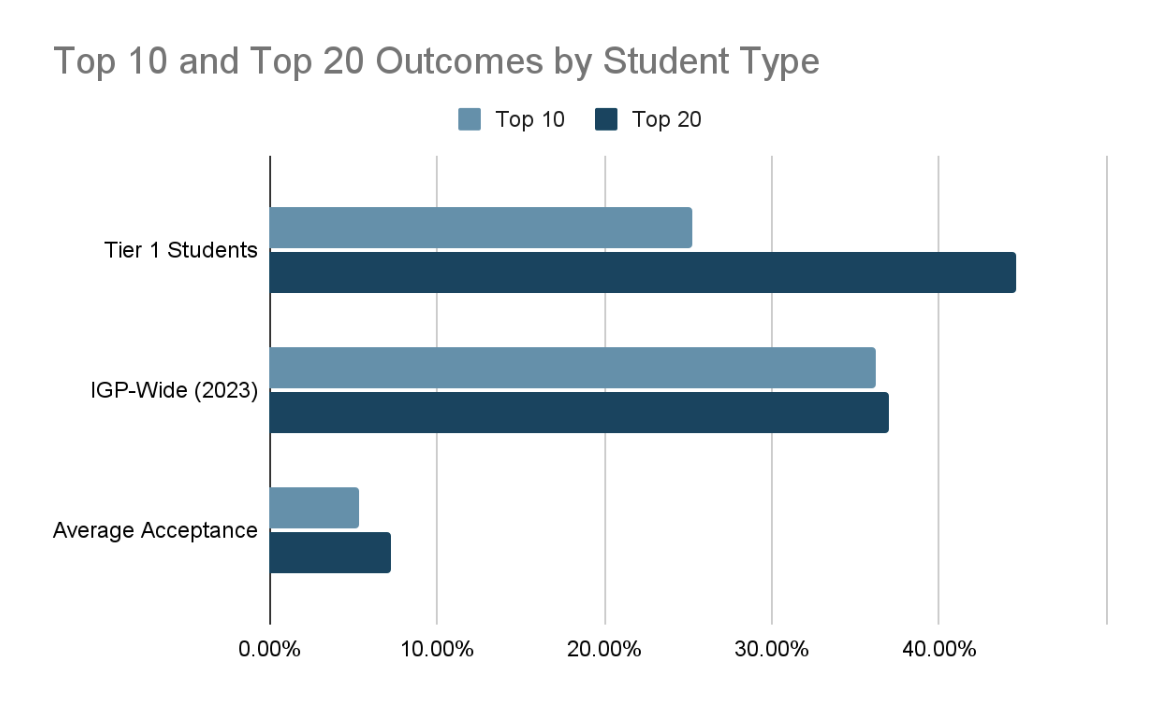
At the student level, the Tier 1 cohort demonstrates admissions outcomes that diverge meaningfully from the 2023 IGP population, though for reasons that require careful interpretation. The table below reflects the core comparison:
Data
| Group | Top 10 | Top 20 |
| Tier 1 Students (n=119) | 25.21% | 44.54% |
| IGP-Wide (2023) | 36.16% | 37.00% |
| Average Acceptance | 5.31% | 7.22% |
Within the Tier 1 dataset, 30 of the 119 students (25.21%) received at least one Top 10 offer, and 53 students (44.54%) received at least one Top 20 offer. These results represent students, not offers—meaning that once a student receives a qualifying acceptance, they are counted once, regardless of how many selective offers they receive.
These percentages produce two important takeaways. First, roughly one in four Tier 1 participants earns a Top 10 offer, underscoring that Tier 1 students are competitive within the most selective tier of U.S. universities. Second, nearly one in two earns a Top 20 offer, revealing a strong alignment between Tier 1 participation and broader selective admissions success. As expected—and consistent with the mathematics of set inclusion—no student received a Top 10 offer without also receiving a Top 20 offer.
However, the Tier 1 Top 10 percentage is lower than the IGP-wide 2023 rate, while the Tier 1 Top 20 percentage is higher. This does not indicate weaker performance; instead, it illustrates the influence of application patterns, multi-year sampling, and self-selection, which are addressed later in this section.
Data
| Group | Top 10 | Top 20 |
| Tier 1 Students (2021-2023) (n=119) | 25.21% | 44.54% |
| IGP-Wide (2023) | 36.16% | 37.00% |
| Average Acceptance | 5.31% | 7.22% |
A multi-cycle Tier 1 sample shows a higher Top 20 alignment compared to the 2023 IGP-wide population, and a lower Top 10 alignment, reflecting different application distributions and sample sizes.
2. Record-Level Outcomes: Offer Rates Across 1,228 Applications
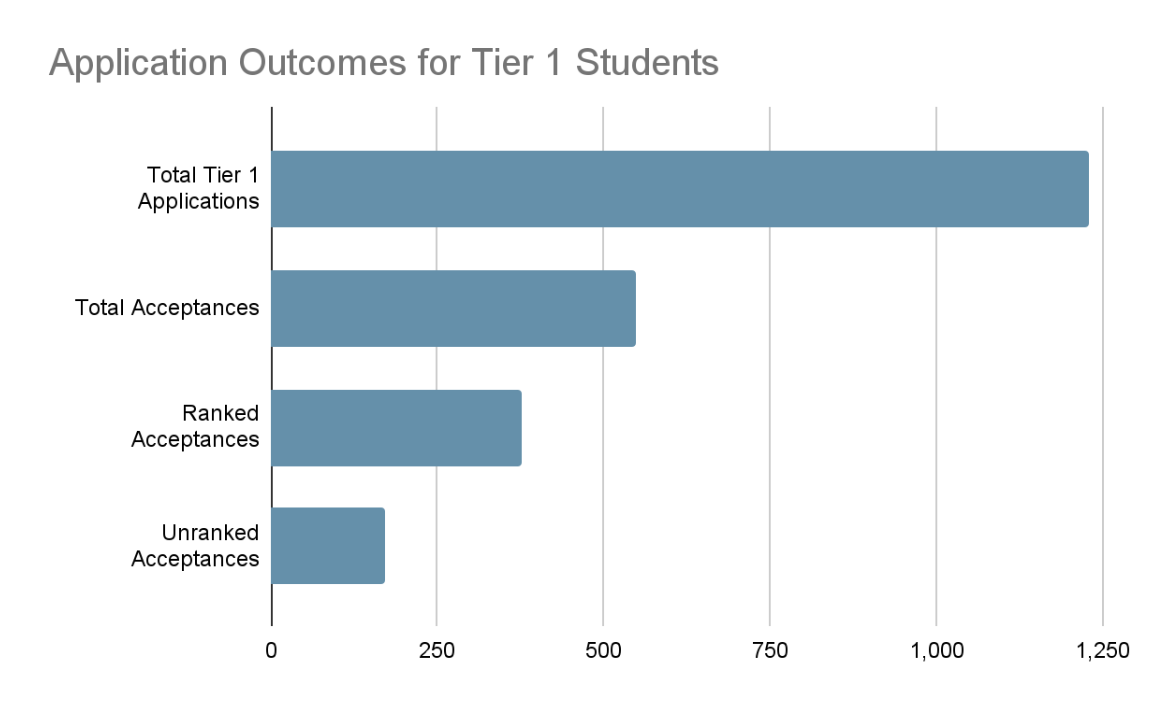
Moving from students to applications provides a more granular view of how Tier 1 participants performed across their entire admissions portfolios. Among the 1,228 total applications, Tier 1 students earned:
- 47 Top 10 acceptances (3.83%)
- 98 Top 20 acceptances (7.98%)
- 547 total acceptances across all ranks
Because some students received multiple acceptances within the same ranking band, these totals exceed the student-level counts. This dynamic is especially visible in the Top 10 and Top 20 categories:
- 30 students received 47 Top 10 offers, averaging ~1.6 Top 10 acceptances per student who received one.
- 53 students received 98 Top 20 offers, averaging ~1.85 Top 20 acceptances per student who received one.
These numbers highlight a key pattern: Tier 1 students who are competitive at the highest levels are often competitive at multiple institutions within those bands. Record-level data, therefore, helps illuminate not just whether Tier 1 students succeed, but the degree and consistency of their success across applications.
3. Selectivity Distribution: What Ranks Were Tier 1 Students Accepted To?
A deeper understanding emerges when we examine where Tier 1 students were admitted across the ranking spectrum. Of the 547 total acceptances, 376 had assigned ranking metadata, while 171 were unranked or affiliated with institutions outside the ranking scope.
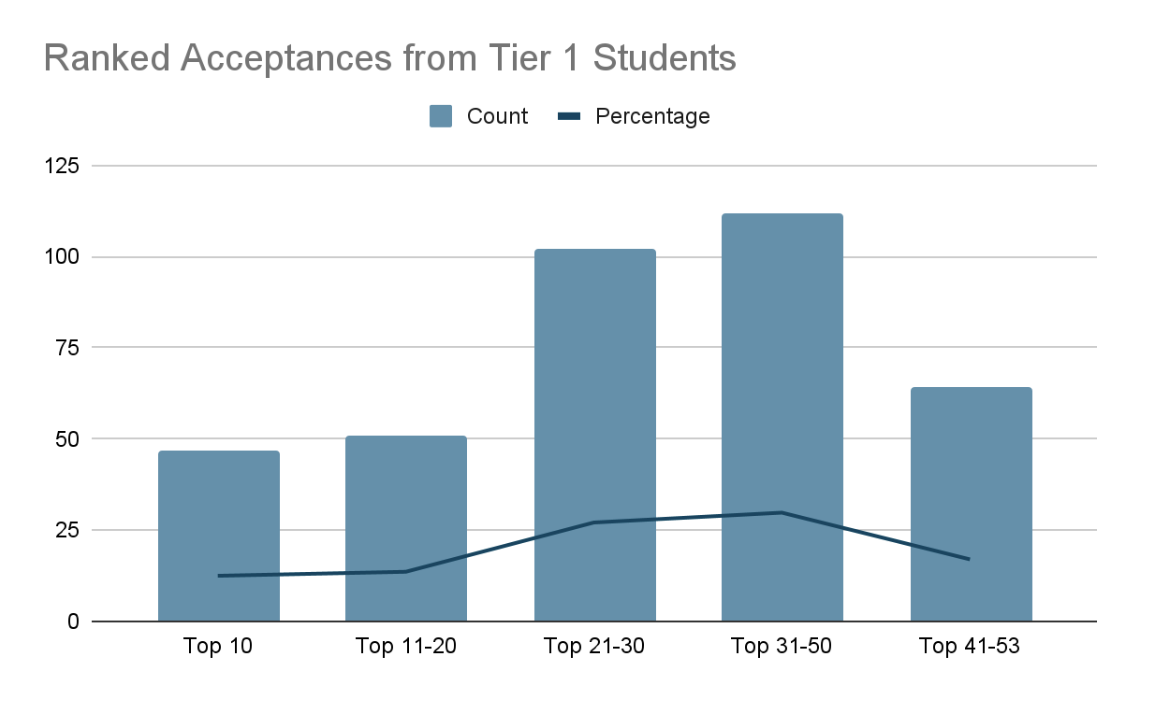
Among the 376 ranked acceptances, the distribution covered institutions from rank 1 through rank 53, with the median acceptance occurring at rank 28. This indicates that the midpoint of Tier 1 acceptances falls well within the selective range, though not at the ultra-elite top.
Breaking the ranked acceptances into bands gives a clearer picture:
Data (Ranked acceptances n=376)
| Rank Band | Count | Percent of Ranked Accepts |
| Top 10 | 47 | 12.5% |
| 11–20 | 51 | 13.6% |
| 21–30 | 102 | 27.1% |
| 31–40 | 112 | 29.8% |
| 41–53 | 64 | 17.0% |
This distribution shows that Tier 1-linked acceptances cluster most heavily in the ranks 21–40, with meaningful but smaller concentrations in the Top 20. The presence of acceptances in every rank band between 1 and 53 demonstrates that Tier 1 students pursue a wide range of selective institutions and achieve results across the full spectrum, not only at the most elite universities.
This pattern reinforces that Tier 1 participation correlates with selective admissions success across a broad range, rather than concentrating narrowly at the top. Instead of driving a single type of outcome, Tier 1 programs appear to align with a student population that targets selective schools in multiple tiers and succeeds across many of them.
Data (Ranked acceptances n=376)
| Rank Band | Count | Percent of Ranked Accepts |
| Top 10 | 47 | 12.5% |
| 11–20 | 51 | 13.6% |
| 21–30 | 102 | 27.1% |
| 31–40 | 112 | 29.8% |
| 41–53 | 64 | 17.0% |
Tier 1-linked acceptances cluster most heavily in ranks 21–40, with meaningful representation across the Top 20.
Interpretation:
- Tier 1 acceptances cluster heavily between ranks 21–40.
- This reinforces that Tier 1 participation correlates with targeting and accessing selective colleges across a spectrum—not only the ultra-elite.
4. Program-Level Patterns: Directional Signals, Not Predictions
When viewed through the program-level dataset, the results provide directional—but not predictive—insights. Across 132 Tier 1 program completions, the dataset shows:
- 34 completions that later contributed to Top 10 admits (~25.76%)
- 60 completions that later contributed to Top 20 admits (~45.45%)
Because students may complete more than one Tier 1 program, these percentages do not map directly onto individual success rates and must be interpreted carefully. What they show instead is the rate at which program completions appear in the full collection of later selective outcomes.
Thus, program-level analysis offers pattern recognition, not a ranking system. It would be incorrect—and statistically unsound—to claim that certain programs “produce” Top 10 or Top 20 acceptances. Given the small Ns and the confounding variables inherent in student self-selection, the program-level patterns serve as a descriptive rather than predictive lens.
5. Comparison to IGP-Wide 2023 Outcomes
To contextualize the results, the Tier 1 dataset is compared to the baseline of IGP-wide 2023 outcomes, where:
- 36.16% of IGP students received at least one Top 10 offer
- 37.00% received at least one Top 20 offer
When placed side-by-side:
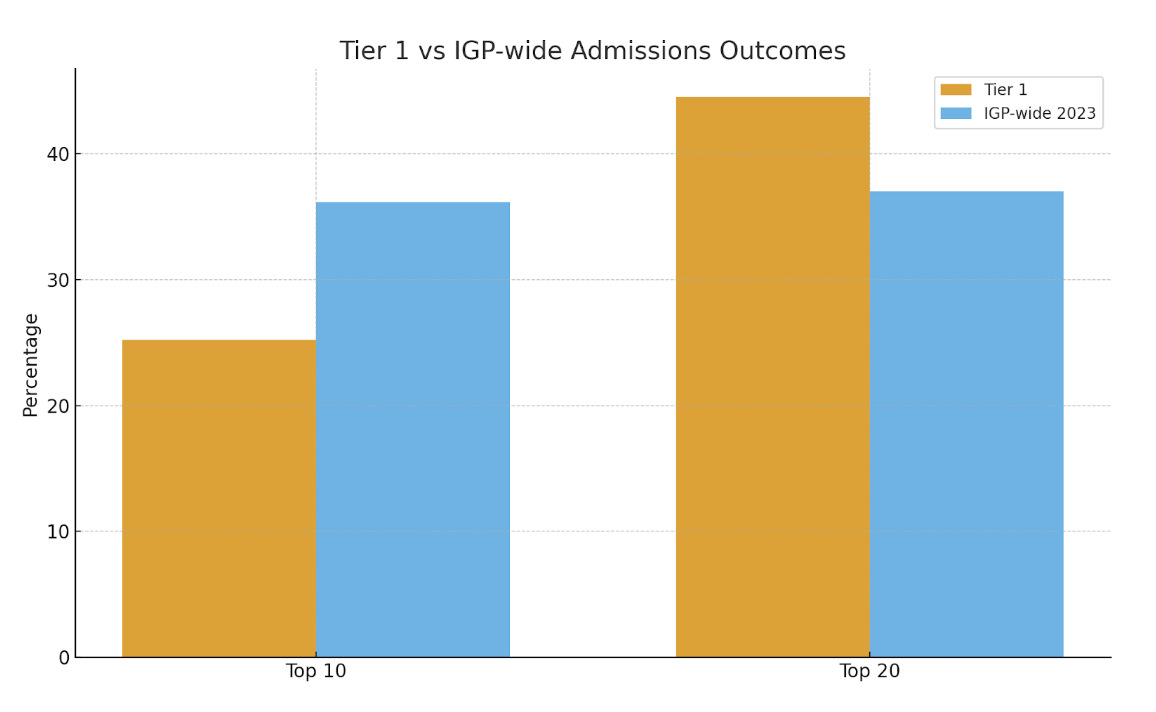
- For Top 20 outcomes, Tier 1 students show higher alignment (44.5% vs. 37.0%).
- For Top 10 outcomes, Tier 1 students show lower alignment (25.2% vs. 36.16%).
These differences reflect several structural factors: multi-cycle vs. single-cycle mismatches, the highly ambitious application patterns of Tier 1 students, and the small sample size of the Tier 1 cohort. As noted earlier, Tier 1 students typically apply to more Top 10 and Top 20 schools, which increases denominator effects and contributes to the observed differences.
The safest and most statistically responsible interpretation is that Tier 1 participation correlates with higher overall Top 20 admissions alignment in this dataset, while other comparisons require more caution due to structural differences between cohorts.
IGP-wide (2023):
- 36.16% received Top 10 offers
- 37.00% received Top 20 offers
Comparisons:
- Top 20:
Tier 1 = 44.5%
IGP 2023 = 37.0%
→ Tier 1 shows higher Top 20 alignment. - Top 10:
Tier 1 = 25.2%
IGP 2023 = 36.16%
→ Tier 1 shows lower Top 10 rates, likely due to extreme targeting patterns.
Interpretation:
Tier 1 participation correlates with application to more selective schools, but the small sample and multi-cycle mismatch limit direct cohort-to-cohort comparisons.
The only safe claim is that Tier 1 participation is associated with higher overall Top 20 admissions alignment in this dataset.
V. Why These Patterns Make Sense: Connecting the Data to Research
The patterns that emerge from the Tier 1 dataset do not exist in isolation; they align closely with decades of educational research on academic rigor, mentoring, identity development, and college readiness. Understanding the broader literature helps explain why Tier 1 students demonstrate strong Top 20 alignments, why they often pursue ambitious academic pathways, and why Tier 1 participation appears to track with selective admissions outcomes even when controlling for self-selection. The alignment between internal data and external scholarship strengthens the overall interpretation: Tier 1 programs matter not because of prestige, but because of the academic experiences they facilitate.
1. Rigorous Experiences Shape Academic Trajectories
One of the strongest research foundations comes from experimental work on selective STEM summer programs. A randomized controlled trial by Griffith et al. (2022) found that participation in highly selective STEM programs causally increased students’ likelihood of enrolling in elite colleges, completing STEM degrees, and persisting in rigorous academic pathways. This study is significant because true causal research in education is rare; most summer program evaluations rely on correlational evidence. Griffith et al.’s findings suggest that when students engage deeply with demanding academic content—especially when challenged to produce work at or above the level expected in early college—they develop skills, confidence, and self-belief that meaningfully shape their trajectories.
The mechanisms underlying these effects map directly onto what Tier 1 programs demand: advanced problem solving, research experience, collaborative inquiry, and exposure to disciplinary thinking. In this sense, Tier 1 participation is not merely an extracurricular choice; it is an immersion in academic rigor that has documented long-term effects on college pathways.
2. Structured Academic Summers Improve College Readiness
Research on summer bridge programs—a distinct but conceptually related category—provides additional context. Meta-analyses and longitudinal studies show that students who participate in structured summer programming prior to college experience improved first-year GPA, higher retention rates, and greater feelings of preparedness (Garcia, 2012; Lane, 2023). Bridge programs typically target students transitioning into college, but the underlying mechanisms apply to high school students as well: structured challenge, exposure to expectations beyond high school, and access to mentorship.
While Tier 1 programs differ from bridge programs in selectivity and purpose, both share core components: they introduce students to college-level academic expectations, foster independent work habits, cultivate resilience, and offer support from educators who model disciplinary thinking. These parallels help explain why Tier 1 students often demonstrate stronger Top 20 alignment; they experience an academic on-ramp long before they begin writing their applications.
3. Mentorship + Research = Stronger Academic Identity
Another consistent finding in the literature is that mentorship and research experiences significantly shape academic identity, particularly in STEM fields. Studies by Chemers et al. (2011), Hernandez et al. (2013), and Sadler et al. (2021) collectively show that students who participate in mentored research during high school or early college develop higher academic self-efficacy, a stronger sense of belonging in the field, and a clearer intention to pursue rigorous disciplines.
Many Tier 1 programs—including RSI, MOSTEC, college-affiliated research internships, and writing studios—operate on precisely this model. Students engage directly with faculty or expert mentors, receive structured feedback, and produce original academic or creative work. These experiences help students begin to view themselves not just as learners, but as emerging scholars. The internal Tier 1 dataset reflects this identity formation: students who see themselves as researchers or thinkers are more likely to apply to selective institutions that match their academic ambitions.
4. Prestige Alone Isn’t a Signal — Selectivity Is
A critical distinction in the summer program landscape is the difference between prestige by association and prestige by selectivity. Research and admissions commentary consistently reinforce that programs with high admittance rates—even when hosted by Ivy League institutions—do not influence admissions outcomes because they do not evaluate academic ability. Articles such as Ivy Coach (2023) and Ravaglia (2025) highlight that Ivy-brand pre-college programs function primarily as revenue-generating enrichment, costing thousands of dollars but requiring minimal preparation or academic vetting.
Admissions officers routinely note that participation in these programs signals financial resources more than intellectual distinction. By contrast, selective academic programs that require essays, recommendations, and evidence of advanced preparation can matter because they demonstrate readiness for rigorous academic work. Tier 1 programs fall squarely into this category: their value lies not in their location, but in their selectivity, curriculum, and expectations.
5. Admissions Decisions Still Prioritize Core Indicators
Even with the value of rigorous summer experiences, it is important to acknowledge that summer programs are not central determinants in admissions decisions. According to the National Association for College Admission Counseling (NACAC, 2023), the most influential factors remain:
- GPA
- Course rigor
- Grades in academic subjects
- Sustained extracurricular involvement
- Essays and recommendations
Summer programs contribute indirectly by enriching these core components. For instance, rigorous summer work can produce compelling essay material, deepen intellectual curiosity, strengthen letters of recommendation, and help students articulate an academic narrative grounded in authentic experience. Tier 1 programs, then, act as inputs into the factors colleges value most, rather than functioning as stand-alone credentials.
6. Why Tier 1 Correlates With Strong Top 20 Outcomes
When the internal Tier 1 dataset is viewed alongside the research literature, a coherent explanation emerges for why Tier 1 students show strong alignment with Top 20 admissions outcomes. Several mutually reinforcing mechanisms help explain the pattern:
- Selection: Students competitive enough to earn Tier 1 admissions already demonstrate academic promise in grades, rigor, and extracurricular depth.
- Preparation: Tier 1 programs expose students to levels of academic challenge that mirror early college coursework, making them better prepared for selective admissions expectations.
- Mentorship: Access to evaluative feedback and disciplinary guidance strengthens students’ writing, inquiry, and reasoning skills—critical components of competitive applications.
- Identity: Students develop academic self-concept and confidence, which leads them to pursue ambitious majors and apply to more selective schools.
- Authenticity: Students who have completed rigorous, high-quality academic work write essays that resonate with admissions readers because they are grounded in substance rather than résumé padding.
- Trajectory: Longitudinal research shows that early exposure to rigorous academic environments can influence long-term academic pathways, major selection, and persistence.
These mechanisms operate in tandem. They do not suggest that Tier 1 programs cause selective admissions outcomes, nor do they imply that Tier 1 participation is a universal prerequisite. Instead, they reveal that Tier 1 involvement functions as a signal of academic seriousness and a contributor to developmental trajectory. The internal data aligns with the research: Tier 1 experiences correlate most strongly with Top 20-level outcomes, where rigor and sustained academic engagement are most influential.
VI. Guidance for Families — When Tier 1 Is Useful, and When It’s Not
Families often approach summer planning with a mix of optimism and anxiety, hoping to choose programs that will both enrich their student’s learning and support future college admissions goals. The question “Should my child pursue a Tier 1 program?” is one of the most common—and one of the most misunderstood—questions in this landscape. The research and internal data suggest that Tier 1 programs can be meaningful when they align with readiness, interest, and developmental timing. But they are not universally beneficial, nor are they always the right choice for every student.
The most accurate and research-aligned answer is: it depends on the student’s academic foundation and their readiness for rigorous, college-like work. Students who thrive in Tier 1 settings typically demonstrate early signs of strong academic preparation, curiosity, and independence. For these students, Tier 1 programs can deepen existing strengths, provide access to challenging academic environments, and help refine their scholarly identity. However, when students are not developmentally ready for intensive workloads or do not yet have clarity about their academic interests, Tier 1 programs may feel overwhelming or mismatched. In those cases, pursuing foundational experiences or more exploratory opportunities can be far more beneficial.
When Tier 1 Programs Make Sense
Tier 1 programs tend to be a good fit under several conditions. They are especially valuable when:
- the student has strong academic foundations, such as consistently high grades, a rigorous course load, or exceptional preparation in a specific discipline;
- the student is ready for rigorous, college-like work, demonstrating the ability to handle long assignments, independent research, or advanced problem sets;
- the student has a clear or emerging area of academic interest that would benefit from structured exploration or mentorship;
- the student needs exposure to challenges not available at school, especially for students whose home institution lacks advanced coursework or research opportunities;
- the program’s selectivity and curriculum are verifiable, ensuring that the experience aligns with genuine academic challenge rather than marketing language.
When these conditions are in place, Tier 1 programs can provide acceleration, clarity, and academic depth that meaningfully contribute to a student’s long-term academic trajectory.
When Tier 1 Programs May Not Be Appropriate
On the other hand, Tier 1 programs are not ideal for every student or every stage of development. They may not be the right fit when:
- the student is early in high school and still exploring, without a clear sense of what subjects interest them or which academic environments suit them best;
- the student needs foundational coursework more than advanced enrichment, such as strengthening writing, algebra, lab skills, or time management;
- the student is not yet ready for high workloads, especially if they are still building stamina, confidence, or independence in academic settings;
- the program’s rigor does not match its branding, a common issue with commercially marketed “prestigious” summer offerings;
- cost or logistics outweigh potential benefit, as some Tier 1 experiences require travel, preparation, or financial investment that is not feasible for every family.
In these cases, students often benefit more from targeted academic support, locally accessible opportunities, or structured but less intense summer options that build the foundation necessary for later success.
A Three-Year Developmental Arc
For families who want to take a long-term approach to summer planning, a gradual developmental arc can help ensure that students pursue opportunities that are appropriate for their stage of growth. A typical progression might look like this:
- After Grade 9:
Students often benefit from exploration, foundational skill-building, and light enrichment. This might include introductory academic courses, writing workshops, test preparation, or local activities that help them clarify interests without the pressure of high-stakes performance. - After Grade 10:
This is often a natural moment for students to attempt Tier 2 programs or competitive Tier 1 opportunities. Many students are developmentally ready to engage with more rigorous content, and early experiences can help them refine future academic goals. Interest development is especially important at this stage. - After Grade 11:
Students who are ready for the highest levels of academic challenge often pursue capstone experiences during this summer. These might include research programs, national academic institutes, advanced mentorship, or select Tier 1 programs that align with their academic profile. This is also the summer when students begin application counseling, finalize standardized testing, and articulate their academic narrative in essays.
Throughout this arc, the priority is not to “collect” Tier 1 programs, but to build an authentic academic identity. The value of a summer experience comes from what a student learns and how it shapes their thinking—not from the logo on the brochure.
VII. Conclusion — What Tier 1 Programs Reveal About Academic Pathways and Admissions Today
Selective college admissions are often described as unpredictable, opaque, or even chaotic—an ecosystem shaped by shifting institutional priorities, demographic pressures, and the proliferation of contradictory advice available to families. But when we examine outcomes through a more structured lens—one grounded in academic rigor, developmental progression, and authentic intellectual engagement—patterns begin to emerge. Tier 1 summer programs illuminate one of those patterns. They matter not because they function as admissions boosters, but because of where they sit within a broader academic arc: at the intersection of preparation, curiosity, mentorship, and student self-selection.
The internal data presented in this analysis shows that students who participate in Tier 1 summer programs often pursue more selective academic pathways and apply to more competitive colleges. Nearly half of the Tier 1 students in the multi-year sample earned at least one Top 20 offer, and one in four earned a Top 10 offer. While these outcomes vary from IGP’s single-year 2023 data—especially due to cohort differences, multi-cycle sampling, and self-selection—they meaningfully align with what the broader research literature has shown for years. When students engage deeply with rigorous academic environments before college—particularly those involving mentorship, inquiry, and authentic challenge—they develop skills, confidence, and scholarly identity that map closely onto success in selective admissions (Griffith et al., 2022; Hernandez et al., 2013; Sadler et al., 2021).
What Tier 1 participation signals, then, is not a shortcut or formulaic pathway, but a trajectory. Students who earn seats in these selective programs tend to be the same students who push themselves in advanced coursework, who demonstrate sustained engagement in their areas of interest, who seek mentorship, and who remain curious even in the face of academic difficulty. These students build intellectual lives that extend beyond the classroom, and it is this developmental arc—not the summer program itself—that admissions officers ultimately recognize.
At the same time, the data makes an equally important point: Tier 1 programs are neither necessary nor sufficient for admission to selective colleges. Many Tier 1 students do not receive Top 10 offers, and many non–Tier 1 students achieve extraordinary results without ever attending a competitive summer program. Core academic indicators—grades, rigor, meaningful extracurricular contributions, and authentic stories of growth—remain the foundation of selective admissions (NACAC, 2023). Tier 1 programs can enrich those foundations by offering depth and direction, but they cannot replace them.
For families, the most significant takeaway is not that students should pursue Tier 1 programs at all costs, but that they should seek intellectually honest environments that challenge them appropriately. Students benefit when they engage in experiences that stretch their thinking, expose them to new ideas, and allow them to test their academic interests in meaningful ways. Tier 1 programs provide one such environment. But so do thoughtfully designed research experiences, sustained extracurricular commitments, advanced coursework, and strong mentorship during the school year.
In an admissions landscape saturated with marketing language, prestige-driven messaging, and programs that promise more than they deliver, clarity is essential. What matters most is not the name of a program, but the quality of engagement it fosters and the intellectual habits it helps students develop. When summer opportunities align with readiness, interest, and long-term goals, they become part of a student’s academic story—not because of where they occur, but because of what the student becomes through the experience.
The data in this analysis underscores a simple but often overlooked truth: when students seek out rigorous academic environments and rise to meet their expectations, the outcomes—both personal and academic—tend to follow naturally. And while the admissions process will always retain elements of unpredictability, the patterns surrounding Tier 1 programs remind us that genuine learning, curiosity, and commitment remain at the heart of what selective colleges value most.
References
Chemers, M. M., Zurbriggen, E. L., Syed, M., Goza, B. K., & Bearman, S. (2011). The role of efficacy and identity in science career commitment among underrepresented minority students. Journal of Social Issues, 67(3), 469–491. https://doi.org/10.1111/j.1540-4560.2011.01710.x
Garcia, P. (2012). Summer bridge programs and college success: A meta-analytic review. Journal of STEM Education, 13(2), 49–56. https://www.jstem.org/jstem/index.php/JSTEM/article/view/1682/1412
Griffith, A. L., et al. (2022). The long-term impacts of selective STEM summer programs for underrepresented youth. National Bureau of Economic Research Working Paper Series, No. 30227. https://www.nber.org/papers/w30227
Hernandez, P. R., Schultz, P. W., Estrada, M., & Woodcock, A. (2013). Undergraduate research experiences and STEM success: The role of psychological mediators. Science Education, 97(1), 63–79. https://doi.org/10.1002/sce.21051
Ivy Coach. (2023). Elite universities’ summer programs are making millions—but do they help kids get in? The Washington Post. https://www.ivycoach.com/press/the-washington-post/americas-elite-universities-are-making-millions-off-summer-programs-for-teens-but-do-they-really-help-kids-get-into-college/
Lane, T. (2023). The impact of college summer bridge programs on academic performance and retention. Journal of College Student Retention. https://journals.sagepub.com/doi/10.1177/15210251231214183
National Association for College Admission Counseling. (2023). State of College Admission Report. https://www.nacacnet.org
Ravaglia, R. (2025). The summer programs that will boost your college admissions prospects. Forbes Magazine. https://www.forbes.com/sites/rayravaglia/2025/03/10/the-summer-programs-that-will-boost-your-college-admissions-prospects/
Sadler, T. D., Burgin, S. R., McKinney, L., & Ponjuan, L. (2021). Learning science through research apprenticeships: Long-term outcomes from a decade of research-based STEM programming. International Journal of Science Education, 43(5), 711–733. https://eric.ed.gov/?id=EJ881429