
Avoiding Overload, Burnout, and Bad Strategy
By Lindsey Kundel, Editor in Chief, InGenius Prep
An Opening Note to Parents
If you are the parent of a high school junior, you may already feel it.
Your child is busier than ever—yet more tired, more irritable, or more uncertain. Schoolwork has intensified. Conversations about grades, testing, leadership roles, and “what colleges want” feel heavier. Decisions that once felt manageable now carry an uncomfortable sense of permanence. You may find yourself wondering whether this level of stress is normal, necessary, or somehow avoidable.
Most families experience junior year this way. That does not mean it is inevitable—or that it is healthy.
This journal is built on a simple but often overlooked premise: junior year is difficult not because students lack discipline, resilience, or ambition, but because too many high-stakes demands are stacked at once—during a developmental window when recovery, judgment, and emotional bandwidth are under real strain.
In other words, junior year is not just hard. It is a bottleneck.
What We Mean by “The Bottleneck”
A bottleneck is a systems concept. It describes a point where flow slows not because effort has decreased, but because capacity has been exceeded.
In junior year, multiple pressures converge at the same time:
- Academic rigor peaks, often with the heaviest course loads students will ever carry.
- Grades take on outsized meaning as “the last full academic signal.”
- Standardized testing intensifies.
- Leadership expectations shift from participation to impact.
- Students are asked—sometimes implicitly, sometimes explicitly—to begin defining who they are as applicants and as people.
None of these pressures is inherently unreasonable on its own. The problem is how they are layered.
When too many demands arrive simultaneously, something has to give. And what usually gives first is not grades, but sleep, recovery, flexibility, and clarity of judgment—the very capacities students need to navigate this year well.
Why This Matters More Than We Acknowledge
Junior year stress is often treated as a rite of passage. Parents are told to expect it. Students are told to push through it. When cracks begin to show, the response is often to add coping strategies rather than to examine whether the load itself makes sense.
But research tells a more nuanced—and more actionable—story.
Periods of intense academic pressure are associated with increased emotional distress in adolescents. Burnout is not simply exhaustion; it includes loss of meaning and reduced confidence. Sleep deprivation erodes emotional regulation and decision-making. Under chronic pressure, students may work harder while thinking less clearly.
This is where junior year becomes uniquely risky.
Burnout does not only threaten wellbeing. It quietly degrades strategy.
Students under sustained pressure are more likely to make reactive choices: over-stacking courses, chasing prestige without coherence, abandoning long-term projects for short-term optics, or freezing altogether. These are not failures of character. They are predictable outcomes of operating beyond capacity.
A Reframe for Families
This journal is not an argument for doing less, caring less, or lowering standards.
It is an argument for doing junior year differently.
The goal is not maximal productivity. It is coherent strategy under constraint.
That means:
- Understanding which pressures are structural—and therefore predictable.
- Recognizing the early signs of overload before crisis sets in.
- Protecting recovery and meaning as strategic assets, not luxuries.
- Designing junior year so that effort actually pays off, rather than being diluted by exhaustion.
Most importantly, it means shifting the parental role away from constant monitoring and toward architecting conditions in which your child can do their best thinking and most meaningful work.
What This Journal Will Do
Over the pages that follow, we will:
- Ground the junior-year experience in credible research on academic stress, burnout, and adolescent development.
- Explain why overload leads not just to exhaustion, but to poor decision-making.
- Help you distinguish healthy challenge from destructive strain.
- Offer a clear framework for sequencing, pruning, and protecting commitments.
- Provide practical tools for supporting your child without increasing pressure.
This is not about perfection. It is about foresight.
Junior year does not have to be survived. It can be designed.
Section I

What the Research Shows
Academic Stress, Burnout, and the Junior-Year Bottleneck
To understand why junior year feels so different—and why simply “pushing through” so often backfires—we need to look beyond anecdotes and examine what the research actually tells us about adolescent stress, burnout, and performance under pressure.
Across disciplines, the findings are remarkably consistent: academic stress is real, measurable, and consequential, especially during periods when demands stack faster than recovery and judgment can keep up.
Academic stress is not subjective noise—it is a documented exposure
In research literature, academic stress (sometimes called academic pressure or academic burden) refers to school-related demands that are perceived as high-stakes, evaluative, and difficult to meet—particularly when students believe these demands will shape future opportunity, identity, or belonging.
A major international systematic review synthesizing studies through late 2022 examined how academic pressure relates to adolescent mental health outcomes, including depression, anxiety, self-harm, and suicidality. Importantly, the review did not treat academic pressure only as a student’s internal perception. It also treated timing within the school year—such as exam periods—as a legitimate proxy for pressure exposure.
This matters. It confirms that stress spikes are not merely individual reactions; they are often structurally predictable, tied to the way schools organize evaluation and workload. When pressure concentrates in specific windows, the risks increase—not because students suddenly become weaker, but because systems ask more than the moment can reasonably sustain.
Why timing matters more than raw workload
One of the most common misconceptions about academic stress is that it is primarily about volume: too many assignments, too many hours, too much work. The research suggests a more precise explanation.
Stress becomes damaging not simply when students are busy, but when multiple high-stakes demands are layered simultaneously, leaving little room for recovery or recalibration.
Junior year exemplifies this pattern. It is often the first year in which students face:
- Their most rigorous course load,
- Grades that feel irrevocable,
- Major standardized testing,
- Heightened leadership and extracurricular expectations,
- And implicit pressure to “lock in” an identity or narrative.
None of these pressures is inherently problematic. The problem is that they are rarely sequenced. When everything matters at once, students lose the ability to prioritize effectively—and pressure escalates.
Burnout explains what parents often misinterpret
In educational psychology, burnout is not defined as laziness, disengagement, or lack of ambition. It is a three-part syndrome:
- Exhaustion – sustained depletion from academic demands
- Cynicism – detachment or loss of meaning toward school
- Reduced efficacy – a declining sense of competence or confidence
This framework is critical for parents.
Exhaustion is usually visible. Cynicism is often misread. Parents may hear “none of this matters” or “school is pointless” and assume defiance or attitude. In the burnout literature, cynicism is understood differently: it is frequently a protective response when effort no longer feels meaningful or effective.
Reduced efficacy often follows quietly. Students who once felt capable begin to doubt their judgment, avoid decisions, or freeze when the stakes feel high. At this point, the issue is no longer just emotional—it becomes strategic.
Sleep and recovery are not optional inputs
Adolescence is a period of heightened vulnerability to sleep loss. Biological shifts in circadian rhythm push teens toward later sleep timing, even as school schedules and workload demands intensify. When academic pressure rises, sleep is often the first thing sacrificed.
Research consistently links insufficient sleep to impaired attention, increased emotional reactivity, and reduced executive function. In plain terms: tired students are worse planners, worse problem-solvers, and more reactive decision-makers.
This has profound implications for junior year. When sleep and recovery erode, students may spend more time working while becoming less efficient, more anxious, and less flexible. The appearance of productivity masks a decline in cognitive quality.
Why pressure degrades judgment—not just wellbeing
The research makes clear that pressure does not affect all students equally. Several psychological factors determine whether stress becomes a manageable challenge or a destructive overload.
One of the most important is perceived control.
When students experience their workload as imposed, evaluative, and tied to approval or fear of failure, motivation becomes externally controlled rather than internally driven. Under these conditions, students may work harder while feeling less agency, less ownership, and less clarity.
Perfectionism compounds the problem. Externally driven perfectionism inflates the cost of every task and makes pruning psychologically intolerable. Students begin to believe that every choice must be optimal, every opportunity must be seized, every weakness must be concealed. Under pressure, this mindset accelerates burnout and undermines decision quality.
This is the mechanism by which junior-year stress turns into bad strategy.
High achievement environments are not neutral
A consistent finding across adolescent research is that high-achievement environments—especially those that equate worth with performance—can function as elevated-risk contexts for internalizing stress, even when students are otherwise advantaged.
Stress in these environments is often normalized. Yet research suggests that when expectations escalate without parallel increases in support, clarity, and recovery, students are more likely to experience emotional strain and disengagement.
Access to informed guidance matters here. Students who receive help sequencing commitments, identifying trade-offs, and protecting recovery are less likely to default to “do everything” strategies. Those without such guidance often compensate with volume—working more because they lack a framework for working smarter.
What intervention research tells us—and what it doesn’t
Schools around the world have implemented programs designed to reduce academic stress and burnout. Systematic reviews of these interventions show mixed results. While some approaches—such as mindfulness-based or cognitive-behavioral programs—can help students cope, the overall evidence base is uneven, and many studies suffer from weak design.
The key takeaway for families is not that interventions are useless. It is that coping skills alone cannot fix structural overload.
Burnout is treatable, but prevention depends far more on how demands are designed, timed, and interpreted than on how much resilience students can muster.
Synthesis: Why junior year becomes a bottleneck
Taken together, the research supports a clear pattern:
When academic demands stack during predictable peak periods, recovery erodes. As sleep and flexibility decline, executive capacity narrows. Perceived control drops. Perfectionism intensifies. Burnout emerges—first as exhaustion, then as cynicism and reduced confidence.
At that point, students are not just stressed. They are operating with degraded judgment.
This is why junior year so often feels chaotic, reactive, and emotionally charged. And it is why addressing stress without addressing strategy is insufficient.
Junior year becomes a bottleneck not because students are incapable—but because too much is asked, too quickly, with too little margin for recovery and reflection.
Understanding the research clarifies why junior year is risky. The next step is learning how to recognize when healthy challenge has tipped into destructive overload—and what early warning signs parents should take seriously.
Section II

From Healthy Challenge to Hidden Overload
Most parents of juniors can sense when something is off—but struggle to name it.
Your child may still be earning strong grades. Teachers may report that everything looks “fine.” From the outside, your student appears functional, busy, even successful. And yet, at home, something has changed.
This section is about learning to distinguish healthy challenge, which builds capacity, from hidden overload, which quietly erodes it.
Why overload is so hard to spot
One of the most dangerous features of junior-year overload is that it rarely announces itself dramatically.
Overload does not usually begin with academic collapse. It begins with compression:
- Less sleep, justified as temporary.
- More urgency, with fewer moments of rest.
- Increased reactivity or emotional flattening.
- A constant sense that everything matters—and nothing can be dropped.
Because high-achieving students are often skilled at maintaining appearances, overload can persist for months before it becomes visible to adults. By the time grades slip or behavior changes dramatically, burnout is often already well underway.
Healthy challenge vs. destructive strain
Healthy challenge has recognizable characteristics:
- Effort feels purposeful, even when difficult.
- Recovery is possible; weekends or breaks restore energy.
- Setbacks provoke reflection, not panic.
- Decisions feel effortful but manageable.
Destructive strain looks different:
- Effort feels endless and indistinguishable.
- Rest no longer restores; fatigue becomes chronic.
- Small setbacks trigger outsized emotional responses.
- Decision-making becomes fraught, avoidant, or impulsive.
The key distinction is not how busy your child is—but whether capacity is expanding or contracting.
Early warning signs parents should take seriously
Parents often wait for “proof” that something is wrong. The research suggests that waiting is unnecessary—and unhelpful.
Early warning signs of overload frequently include:
- Sleep compression
Later bedtimes, difficulty waking, or constant tiredness—even on weekends. - Emotional volatility or numbness
Increased irritability, tearfulness, or emotional flatness. - Cynicism or disengagement
Statements like “none of this matters” or “school is pointless” are often misread as attitude rather than distress. - Decision paralysis
Difficulty making choices, starting tasks, or committing to plans that previously felt manageable. - Perfectionistic escalation
More time spent on assignments without improved outcomes; fear of turning work in. - Loss of perspective
Every grade, test, or activity feels make-or-break.
None of these signs alone is alarming. Together, they indicate a system under strain.
Why cynicism deserves special attention
Of all burnout signals, cynicism is the most frequently misunderstood.
When students say they “don’t care,” parents often respond with pressure, concern, or frustration. In the burnout literature, cynicism is understood as a protective response—a way of distancing oneself emotionally when sustained effort no longer feels meaningful or effective.
Cynicism is not a sign that a student has stopped caring. It is often a sign that they have cared intensely for too long without adequate recovery or clarity.
Responding to cynicism with increased pressure can accelerate burnout. Responding with curiosity and recalibration can interrupt it.
Why “this is just how junior year is” is a dangerous myth
Many families normalize junior-year stress by telling themselves—and their children—that this level of strain is simply unavoidable.
The research does not support this conclusion.
While junior year is structurally demanding, burnout is not universal. Students with better sequencing, clearer priorities, protected recovery, and informed guidance show significantly better emotional and strategic outcomes—even in rigorous environments.
The difference is not grit. It is design.
A reframing question for parents
Instead of asking:
“Can my child handle this?”
The more useful question is:
“Does this year make sense as it is currently structured?”
If the answer is no, the solution is not to demand more resilience—but to redesign the load.
Recognizing overload early is protective. But understanding why overload so often leads to poor decisions is equally important. In the next section, we’ll examine how pressure quietly degrades strategy—and why junior year is uniquely vulnerable to bad decision-making.
Section III

Why Overload Produces Bad Strategy
When Pressure Distorts Judgment
Parents often enter junior year focused on effort. Are my child’s grades strong enough? Are they taking enough challenging courses? Are they involved in the “right” activities?
What the research suggests—and what families experience repeatedly—is that effort alone is not the deciding factor in junior-year success. Under sustained pressure, even highly capable students begin to make decisions that undermine both well-being and long-term outcomes.
This is not because they stop trying. It is because pressure changes how the brain prioritizes, evaluates risk, and plans ahead.
Stress narrows thinking
When students operate under chronic academic pressure, cognitive resources are diverted toward immediate demands. Planning, reflection, and long-range reasoning become harder—not because students lack intelligence, but because stress consumes bandwidth.
Under these conditions:
- Urgency crowds out importance.
- Short-term relief is favored over long-term coherence.
- The ability to compare options thoughtfully declines.
Junior year is uniquely vulnerable because it is the first time students are asked to make strategic, multi-month decisions—course selection, leadership commitments, testing plans, and narrative direction—while operating under sustained evaluative pressure.
How bad strategy masquerades as productivity
One of the most dangerous features of junior-year overload is that poor strategy often looks like hard work.
Common patterns include:
- Over-stacking rigor
Adding more advanced courses than can be meaningfully sustained, resulting in diminished learning and increased exhaustion. - Prestige chasing without coherence
Pursuing selective programs, competitions, or leadership roles that do not connect meaningfully to interests or long-term goals. - Shallow leadership accumulation
Holding titles without scope, continuity, or real impact. - Last-minute reinvention
Abandoning viable long-term projects late in the year in favor of rushed initiatives designed to “look impressive.” - Decision avoidance
Delaying choices until deadlines force reactive decisions.
Each of these behaviors can be explained as a rational response to pressure. When everything feels high-stakes, students hedge by doing more—even when doing more makes everything worse.
Why pressure distorts risk assessment
Under normal conditions, students can weigh trade-offs: depth versus breadth, effort versus recovery, ambition versus sustainability.
Under pressure, trade-offs feel intolerable. Students begin to treat every opportunity as necessary and every constraint as a threat. This leads to risk-averse overextension—a paradoxical pattern in which students take on too much in order to avoid the risk of missing something important.
Perfectionism intensifies this effect. When worth feels contingent on performance, pruning becomes psychologically dangerous. Students fear that choosing less signals weakness or lack of ambition, even when the opposite is true.
The hidden cost: erosion of narrative coherence
One of the least discussed consequences of junior-year overload is its impact on coherence.
Strong applications—and strong educational trajectories—are built on sustained engagement, progression, and meaning. Overload fragments attention. Students bounce between commitments without the time or energy required to develop depth.
The result is not a lack of achievement, but a lack of story.
This is why junior-year burnout often correlates with weaker outcomes than families expect, given the effort invested. The issue is not that students failed to work hard. It is that their work was diluted by pressure.
Why adults often misdiagnose the problem
When parents see their child struggling strategically—dropping balls, changing direction, avoiding decisions—the instinct is often to push harder or tighten oversight.
From the research perspective, this response is understandable but counterproductive. Increased external pressure further reduces perceived control and accelerates the burnout cycle.
What students need at this stage is not more urgency, but less stacking and more clarity.
Reframing the risk of junior year
Junior year is often described as the most important year of high school. That framing, while common, is incomplete.
A more accurate description is this: junior year is the most leverage-sensitive year.
Small design decisions—how commitments are sequenced, how recovery is protected, how choices are framed—have outsized effects on both well-being and outcomes.
The risk is not that students will work too little. The risk is that they will work too much, too reactively, and in ways that undermine the very goals they are trying to achieve.
If overload creates a bad strategy, the solution is not simply “stress management.” The solution is to rethink how junior year is designed. In the next section, we’ll introduce a strategic reframe—one that shifts the focus from discipline to architecture.
Section IV

Junior Year Is a Design Problem, Not a Discipline Problem
By the time families reach junior year, many are already exhausted—students from the workload, parents from the vigilance.
When something feels off, the default response is often disciplinary: tighter schedules, more reminders, additional tutoring, increased monitoring. These interventions are well-intentioned, but they misunderstand the problem.
Junior year rarely fails because students lack discipline. It fails because the system they are operating in has not been designed for sustainability.
The limits of willpower
Willpower is a finite resource. Under sustained stress, it depletes faster and recovers more slowly. Research on motivation and burnout makes clear that when demands escalate without corresponding increases in autonomy, clarity, and recovery, even highly motivated students falter.
Asking a student to “try harder” in an already overloaded system is like pressing the accelerator while ignoring the fuel gauge.
The question families need to ask is not:
“How do we get our child to push through this?”
But rather:
“How is this year structured—and what assumptions are built into that structure?”
A shift in the parental role
One of the most important reframes in this journal is this: parents are not junior-year managers; they are junior-year architects.
Management focuses on execution:
- Did the work get done?
- Was the deadline met?
- Was the grade acceptable?
Architecture focuses on conditions:
- Are demands sequenced or stacked?
- Is recovery protected or sacrificed?
- Are priorities clear or competing?
- Does effort compound—or cancel itself out?
This shift is subtle but powerful. It allows parents to support their child without becoming the enforcer or the pressure source.
The three levers families actually control
Despite how overwhelming junior year can feel, families retain meaningful control over three critical design levers:
1. Sequencing
When things happen.
Not all challenges need to peak at once. Testing, leadership expansion, course rigor, and major projects are often treated as simultaneous expectations—but they do not have to be.
Strategic sequencing spreads cognitive and emotional load across time, reducing peak pressure without lowering standards.
2. Pruning
What does not happen.
Every commitment has an opportunity cost. Pruning is not failure; it is intentional subtraction in service of depth and sustainability.
Families who avoid pruning often discover that “doing everything” results in shallow engagement everywhere.
3. Protection
What must be preserved.
Sleep, physical activity, unstructured time, and emotional recovery are not indulgences. They are infrastructure. When these erode, everything else becomes more expensive.
Protecting recovery is not about comfort. It is about preserving judgment.
Why “doing less” is the wrong frame
Parents sometimes resist pruning because it feels like lowering the bar.
In reality, the opposite is often true.
High-quality effort requires margin. Students who are stretched to capacity have no room to think deeply, reflect, or connect their experiences meaningfully. Reducing stacking does not reduce ambition; it allows ambition to land.
The research supports this distinction. Burnout is not caused by challenge itself, but by chronic misalignment between demand and capacity. Rebalancing the system restores capacity.
A new success metric for junior year
Rather than asking:
- “Is my child doing enough?”
- “Are they keeping up with their peers?”
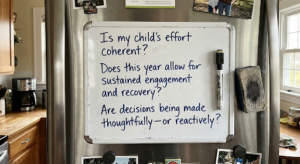
This journal invites families to ask:
- “Is my child’s effort coherent?”
- “Does this year allow for sustained engagement and recovery?”
- “Are decisions being made thoughtfully—or reactively?”
These questions mark the transition from survival to strategy.
Once junior year is understood as a design challenge, families need a way to assess their own situation. The next section introduces a practical diagnostic tool—the Bottleneck Audit—to help identify where overload is forming and where redesign is needed.
Section V

The Bottleneck Audit
A Practical Framework for Junior Year
Understanding junior year as a bottleneck is only useful if families can identify where the pressure is forming and why. The Bottleneck Audit is designed to do exactly that.
This is not a performance evaluation. It is a systems check—a way to assess whether the current junior-year structure supports sustainable effort and sound decision-making.
The goal is not to eliminate challenge, but to reduce unnecessary stacking.
Step 1: Map the demand landscape
Begin by listing the major demands currently placed on your child. For most juniors, these fall into four categories:
- Academics
- Course rigor and workload
- Major assessments and grading periods
- AP/IB exam preparation
- Testing
- SAT/ACT preparation and test dates
- Retakes or additional exams
- Extracurricular commitments
- Leadership roles
- Competitive activities
- Ongoing projects or programs
- Future-facing pressure
- College research
- Narrative uncertainty (“what do I want to study?”)
- External expectations and comparisons
Write these down. Seeing them together often reveals the first problem: too many peaks occurring at the same time.
Step 2: Identify stacking and collision points
Next, examine when these demands peak.
Ask:
- Which commitments intensify simultaneously?
- Where do deadlines, exams, and leadership responsibilities overlap?
- Are there weeks or months with no margin at all?
Stacking is the defining feature of the junior-year bottleneck. The issue is rarely one overwhelming commitment—it is the collision of several.
Step 3: Assess recovery and capacity
Now evaluate what supports your child’s capacity to handle challenge.
Key questions:
- How many hours of sleep does your child get on school nights?
- Is sleep consistent—or constantly sacrificed?
- Is there time for physical activity?
- Are there moments of unstructured downtime?
- Do weekends restore energy, or merely allow survival?
If recovery is already thin, adding new demands—even attractive ones—is likely to degrade outcomes rather than improve them.
Step 4: Evaluate return on effort
Not all commitments are equal.
For each major activity, ask:
- Does this align with my child’s genuine interests?
- Does it allow for growth, progression, or impact?
- Is it connected meaningfully to academic or personal direction?
- Or is it maintained primarily out of fear of “dropping something”?
High return-on-effort commitments are those that compound—deepening skill, clarity, and confidence over time. Low return commitments drain energy without contributing meaningfully to development or narrative.
Step 5: Name red flags that require redesign
Certain patterns indicate that the bottleneck has already formed:
- Chronic sleep deprivation
- Frequent emotional volatility or shutdown
- Paralysis around decisions
- Constant urgency without relief
- Loss of enjoyment or meaning in previously valued activities
When these signs appear, the appropriate response is structural change, not motivational pressure.
What the audit is—and isn’t
The Bottleneck Audit is:
- A conversation starter
- A recalibration tool
- A way to reduce panic and increase clarity
It is not:
- A judgment of effort
- A comparison exercise
- A reason to overhaul everything at once
Often, small changes—shifting a test date, reducing a minor commitment, protecting sleep during peak weeks—have disproportionate effects.
An important reminder
Families sometimes hesitate to adjust junior-year plans out of fear that colleges expect maximal strain.
The research does not support this belief.
What selective colleges consistently reward is sustained engagement, depth, and coherence—all of which are undermined by overload.
Once families identify where the bottleneck is forming, the next challenge is knowing how to intervene without increasing pressure. In the following section, we’ll focus on the parental role: what to do, what to avoid, and how to support junior-year redesign without becoming the source of stress.
Section VI
What Parents Should (and Should Not) Do
Support Without Becoming the Source of Pressure
By junior year, parents are often carrying as much anxiety as their children.
You want to help. You want to protect them. You want to make sure opportunities aren’t missed. And yet, many of the most well-intentioned parental behaviors during this year can unintentionally intensify pressure rather than relieve it.
This section focuses on how parents can intervene strategically, without becoming another stressor in an already overloaded system.
What helps
1. Reduce simultaneous stakes
Whenever possible, avoid letting multiple high-stakes demands peak at the same time.
This might mean:
- Spacing standardized tests rather than clustering retakes.
- Avoiding the addition of new major commitments during exam-heavy months.
- Postponing leadership expansion until academic load stabilizes.
Reducing stacking does not lower ambition—it preserves capacity.
2. Name trade-offs honestly
Students under pressure often believe they must do everything. Parents can counter this by making trade-offs explicit.
Helpful language includes:
- “If we say yes to this, what becomes harder?”
- “What would we be giving up?”
- “Is this the best use of your energy right now?”
Naming trade-offs reduces shame around choosing less and reinforces that strategy—not volume—is the goal.
3. Protect sleep as a strategic asset
Sleep is often treated as negotiable. The research is clear that it is not.
Parents can support junior-year success by:
- Setting reasonable, consistent sleep expectations.
- Resisting the urge to reward late-night work.
- Framing sleep as part of academic performance, not separate from it.
Protecting sleep protects judgment.
4. Reframe success as coherence
Help your child see success not as accumulation, but as alignment.
Questions that build coherence:
- “What connects these commitments?”
- “Which experiences feel meaningful rather than performative?”
- “Where are you actually learning or growing?”
This reframing reduces panic-driven decision-making and preserves motivation.
5. Create pressure-free planning spaces
Students often avoid planning conversations because they anticipate judgment or escalation.
Parents can change this by:
- Separating planning from evaluation.
- Listening more than advising.
- Using curiosity rather than urgency.
When planning feels safe, students think more clearly.
What backfires
1. Micromanagement
Tracking every assignment, deadline, or grade may feel protective, but it often undermines autonomy and increases stress—particularly for adolescents who are already highly conscientious.
2. Fear-based comparisons
Statements like “everyone else is doing more” or “you’ll regret this later” amplify pressure without improving outcomes. They shift motivation from internal to controlled and erode confidence.
3. Last-minute pressure escalations
Raising expectations mid-year—adding commitments, pushing additional tests, or expanding leadership suddenly—often overwhelms capacity and degrades performance.
4. Treating cynicism as defiance
When students express disengagement, the instinct may be to correct their attitude. The research suggests a different approach: treat cynicism as a signal, not a character flaw.
How to talk about junior year
The language parents use matters.
Supportive framing sounds like:
- “Let’s make sure this year makes sense.”
- “We can adjust if something isn’t working.”
- “Your well-being and your outcomes are connected.”
Pressure-amplifying framing sounds like:
- “This is just what it takes.”
- “You can rest later.”
- “We can’t afford mistakes.”
A final reminder
Parents cannot remove all stress from junior year. Nor should they try.
What they can do is prevent unnecessary stress—the kind that arises not from meaningful challenge, but from poor design and unmanaged stacking.
When junior year is redesigned thoughtfully, the benefits extend beyond the immediate moment. In the final section, we’ll look ahead—at how strategic junior years lead to calmer senior years, stronger outcomes, and more confident students.
Section VII

Looking Ahead
Why Getting Junior Year “Right” Makes Everything Easier
Junior year carries a reputation as the most important year of high school. In reality, it is better understood as the most influential.
How this year is structured shapes not only academic outcomes, but confidence, judgment, and emotional resilience moving forward. When junior year is designed thoughtfully, it reduces—not increases—the pressure of what comes next.
Strategic junior years create calmer senior years
Students who emerge from junior year with:
- sustained engagement rather than exhaustion,
- coherent commitments rather than fragmented ones,
- and confidence in their judgment rather than self-doubt,
enter senior year with a fundamentally different posture.
They are better able to:
- reflect on their experiences meaningfully,
- articulate growth and purpose,
- approach applications with clarity rather than panic,
- and maintain emotional balance during an already intense season.
Senior year will still be busy. But it will not feel existential.
Burnout is not a prerequisite for success
One of the most damaging myths families absorb is that intense strain is the price of admission to selective opportunities.
The research does not support this belief.
What selective institutions consistently reward—depth, progression, insight, and authenticity—are precisely the qualities most threatened by overload. Students who are chronically exhausted struggle to sustain the curiosity, reflection, and coherence that make applications compelling.
Avoiding burnout is not a concession. It is a strategic advantage.
What this journal is—and isn’t
This journal is not:
- a checklist of achievements,
- a prescription for perfection,
- or a guarantee of outcomes.
It is an invitation to step back and ask better questions—earlier, and with more calm.
It asks families to treat junior year not as a test of endurance, but as a design challenge that can be approached with foresight rather than fear.
A final word to parents
Your child does not need you to manage every detail of junior year.
They need you to help ensure that:
- effort is not wasted on unnecessary stacking,
- recovery is protected rather than postponed,
- and decisions are made with clarity rather than urgency.
When junior year makes sense, students feel it. They work harder where it matters, rest without guilt, and approach challenges with steadiness rather than dread.
That is the real goal.
Closing Reflection
Junior year does not have to be survived. It can be designed.
And when it is, everything that follows becomes more humane—and more successful.