
By Lindsey Kundel, Editor in Chief, InGenius Prep
Every year, I hear some version of the same question:
“If my child attends a top-ranked university, will that keep every door open — including law school?”
It’s a fair assumption. Prestige feels portable. If a university is elite, surely it functions equally well as a launchpad for medicine, finance, academia, or law. Families often assume that brand strength preserves optionality across all professional paths.
But when we examine how law school admissions actually operate, the story becomes more nuanced.
Law admissions are intensely metric-driven. The American Bar Association (ABA) publishes annual disclosures showing that median LSAT scores and GPA ranges at the most selective programs are tightly clustered and extraordinarily competitive. At top law schools, even a one- or two-point LSAT difference can materially shift outcomes. The Law School Admission Council (LSAC) reinforces this reality: undergraduate major matters far less than demonstrated academic rigor and LSAT performance. Philosophy majors routinely post among the highest average LSAT scores — not because of institutional branding, but because their coursework trains them in logic and argumentation.
In other words, law admissions reward skill development, not logos.
And yet, when we analyze large alumni datasets over time, certain undergraduate institutions appear disproportionately often in the pipelines to the most selective law schools. That does not mean law schools “prefer” those colleges. It does suggest that some undergraduate ecosystems consistently cultivate students who thrive under this admissions formula.
Prestige matters. But prestige alone does not explain density.
A Reverse-Engineered Question: If You Want the Top 7
Rather than looking at all T14 schools collectively, we asked a sharper question:
If a student already knows they want to aim for one of the most selective law schools in the country, where should they consider attending undergrad?
Using the 2025–2026 U.S. News ordering, we examined:
- Stanford
- Yale
- University of Chicago
- University of Virginia
- University of Pennsylvania
- Duke
- Harvard
Three forces consistently shape the feeder picture:
- Vertical selectivity concentration
- Regional gravity
- Institutional continuation (elite-to-elite progression)
When layered together, the patterns become far clearer.
The Regional Gravity Model
Before diving into each school, it’s important to name something that becomes obvious once you examine the spreadsheet closely: regionalism is real.
Students disproportionately attend law school in the same geographic region where they completed undergraduate study. This is not mysterious. Faculty networks are regional. Internship pipelines are regional. Alumni connections are regional. Many students simply build roots during undergrad and remain nearby.
Elite law school placement appears to operate along two axes:
- Vertical axis: institutional selectivity
- Horizontal axis: geographic alignment
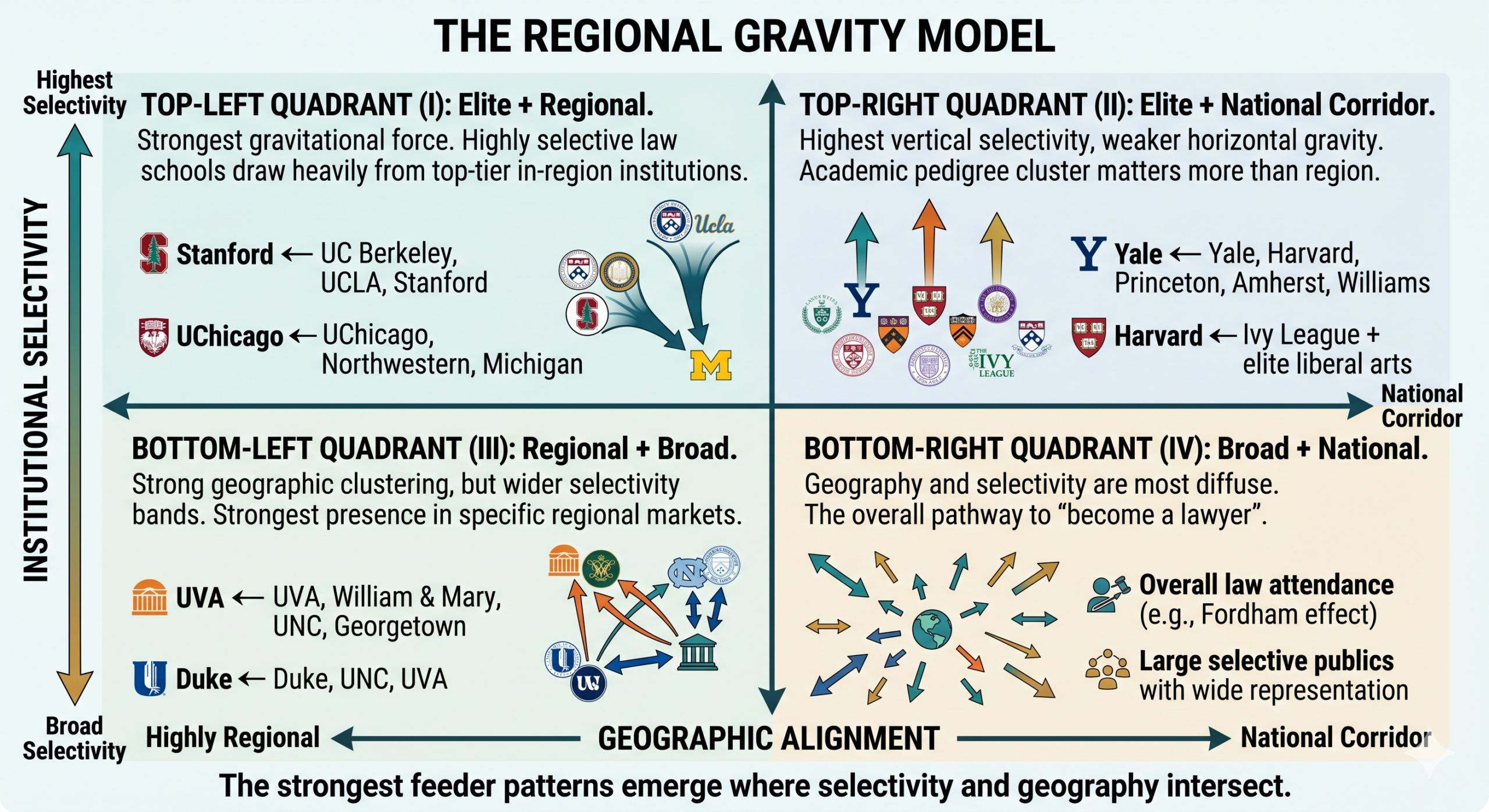
The strongest feeder patterns occur where those two axes intersect.
When we map feeder data across both selectivity and geography, a pattern becomes clear: elite law school placement is not random. It is gravitational.
Highly selective law schools sit at the top of a vertical axis of undergraduate selectivity. But they also operate within regional academic ecosystems that reinforce continuity. Students disproportionately attend law schools in the same region where they built networks, relationships, and academic identities.
The strongest feeder patterns emerge where these two forces intersect.
Students who attend highly selective institutions within the same geographic ecosystem as their target law school sit in the most statistically reinforced quadrant.
What Each Quadrant Represents
Quadrant I: Elite + Regional
These law schools draw heavily from highly selective institutions within their geographic ecosystem.
- Stanford ← UC Berkeley, UCLA, Stanford undergrads
- UChicago ← UChicago, Northwestern, Michigan
These schools exhibit both vertical and horizontal reinforcement. Students embedded in regional elite ecosystems remain within them.
Quadrant II: Elite + National Corridor
These schools draw from the most selective institutions nationwide, often concentrated within an academic corridor.
- Yale ← Yale, Harvard, Princeton, Amherst, Williams
- Harvard ← Ivy League + elite liberal arts
Regional gravity is weaker than vertical selectivity here. The academic pedigree cluster matters more than geography.
Quadrant III: Regional + Broad
These schools show strong geographic clustering but slightly wider selectivity bands.
- UVA ← UVA, William & Mary, UNC, Georgetown
- Duke ← Duke, UNC, UVA
Students disproportionately remain in-region, but feeder selectivity is somewhat more varied than at Yale/Harvard.
Quadrant IV: Broad + National
This quadrant represents schools (or overall law attendance) where geography and selectivity are more diffuse.
- Overall law attendance (e.g., Fordham effect)
- Large selective publics with wide representation
This is where the “become a lawyer” pathway diverges from the “attend a Top 7 law school” pathway.
Top 7 Feeder Core Comparison
When feeder data is analyzed collectively, broad patterns appear. But when we separate the Top 7 and examine them individually, the picture sharpens. Stanford does not look like Yale. Chicago does not look like Virginia. Harvard’s core overlaps with Yale’s, but diverges in meaningful ways. What emerges is not a generic “elite advantage,” but a layered map of selectivity concentration and regional gravity working together.
| Law School | Recurring Core Undergraduate Feeders | Regional Gravity |
| Stanford | Stanford, UC Berkeley, UCLA, Ivy elites | West Coast concentration |
| Yale | Yale, Harvard, Princeton, elite LACs | Northeast elite corridor |
| U Chicago | UChicago, Northwestern, Michigan, Illinois | Midwest clustering |
| UVA | UVA, Georgetown, UNC, William & Mary | Mid-Atlantic density |
| Penn | Penn, Princeton, Columbia | Northeast urban axis |
| Duke | Duke, UNC, UVA, selective privates | Southern anchor |
| Harvard | Harvard, Yale, Princeton, Amherst, Williams | Ivy + Northeast dominance |
Now let’s unpack each individually.
Stanford Law: West Coast Gravity + National Elite Spillover
Stanford’s feeder pattern is deeply West Coast anchored. UC Berkeley and UCLA appear frequently in its pipeline, alongside Stanford undergraduates themselves. At the same time, highly selective national institutions (Harvard, Yale, Princeton) also send graduates west.
This reflects Stanford’s dual identity: a regional powerhouse with national pull. Students already embedded in California’s academic and legal ecosystems show disproportionate representation. Geography interacts with selectivity here in powerful ways.
Yale Law: Ultra-Selective Concentration
Yale’s feeder core is strikingly narrow. Yale undergraduates, Harvard, Princeton, and elite liberal arts colleges such as Amherst and Williams dominate.
Regionalism here is less about geography and more about academic corridor density. The Northeast elite cluster functions almost as a shared intellectual ecosystem. Yale’s small class size amplifies this concentration. Vertical selectivity matters more here than anywhere else.
Yale’s pipeline is not broad. It is vertically stacked.
University of Chicago Law: Midwest Institutional Continuity
Chicago’s feeder model strongly reflects Midwest gravity. UChicago undergraduates, Northwestern, Michigan, and Illinois appear repeatedly.
Students who build networks in the Midwest often remain there for law school. Chicago’s academic culture also rewards analytical intensity, which aligns well with students trained in similar environments.
The Chicago model is less about national Ivy dominance and more about regional ecosystem continuity.
UVA Law: Mid-Atlantic Flagship Density
UVA’s feeder core heavily features Virginia undergraduates, along with Georgetown, UNC, and William & Mary. This is a classic example of flagship density.
Students from selective public institutions in the Mid-Atlantic disproportionately populate UVA’s incoming classes. Geography and institutional culture overlap meaningfully here.
For students targeting UVA specifically, remaining within that regional academic ecosystem appears statistically coherent.
Penn Law: Northeast Urban Clustering
Penn’s feeder patterns reflect Northeast clustering. Penn undergraduates themselves, along with Princeton and Columbia, appear prominently.
Urban academic proximity likely plays a role. Students embedded in Philadelphia, New York, and nearby elite institutions show consistent density.
Penn’s pipeline reflects both selectivity and corridor-based regional concentration.
Duke Law: Southern Anchor with National Pull
Duke’s pattern blends Southern gravity with national representation. Duke and UNC undergraduates appear frequently, alongside UVA and selective privates from beyond the region.
Students embedded in the Southeast show disproportionate density, but Duke also draws nationally from elite institutions.
It functions as a regional anchor with broader reach.
Harvard Law: Ivy Core + Elite Liberal Arts
Harvard’s feeder pattern reflects Ivy League dominance alongside elite liberal arts overperformance. Harvard, Yale, Princeton, Amherst, Williams, and Dartmouth appear prominently.
Here, both vertical selectivity and Northeast corridor density reinforce one another. Harvard Law’s class composition reflects deep entanglement with the most selective undergraduate institutions in the country.
But even here, exceptions exist.
The Liberal Arts Overperformance Effect
Small liberal arts colleges consistently punch above their weight in Top 7 pipelines. Amherst and Williams, in particular, appear repeatedly across multiple elite law schools.
The explanation is not mystical. Seminar-driven pedagogy, sustained writing, faculty mentorship, and daily argumentation mirror the intellectual posture law school demands.
Selectivity matters. Pedagogy amplifies it.
Percentages vs. Scale
When analyzing feeders, denominators matter. Smaller institutions can show high percentages because of smaller graduating classes. Larger public universities may send higher absolute numbers while appearing less dense proportionally.
Both views are meaningful. Percentage reveals concentration. Absolute numbers reveal reach.
The Biggest Surprise: Top Law vs. All Law
When we widen the lens beyond elite placement and examine overall law school attendance, the picture changes.
Institutions such as Fordham University lead in overall law school participation, with roughly 12% of graduates pursuing law degrees. That figure surpasses many Ivy League institutions in total legal participation.
If the goal is to attend Stanford, Yale, Chicago, UVA, Penn, Duke, or Harvard, undergraduate selectivity strongly correlates with representation.
If the goal is simply to become a lawyer, the pathway is much broader. Regional ecosystems, market proximity, and institutional advising often matter more than brand hierarchy.
Ambition level changes the statistical landscape.
Famous Paths: Pattern and Exception
Barack Obama attended Columbia before Harvard Law. Sonia Sotomayor graduated from Princeton before Yale Law. These reflect vertical selectivity concentration.
Hillary Clinton attended Wellesley before Yale Law. Clarence Thomas graduated from the College of the Holy Cross before Yale Law. These paths remind us that exceptional candidates emerge from diverse undergraduate environments.
The data reveals probability. It does not impose limits.
Strategic Implications
For families thinking seriously about law, the question is not simply whether prestige matters. It does. The more useful question is how prestige, pedagogy, and geography intersect.
If a student has a clearly defined Top 7 target, undergraduate strategy should reflect:
- Selectivity alignment
- Regional gravity
- Institutional ecosystem fit
Elite undergraduate institutions are powerful. But they are not interchangeable.
Reverse-engineering the destination sharpens strategy. Prestige opens doors. Alignment determines which ones open most predictably.