

By Lindsey Kundel, Editor in Chief, InGenius Prep
Key Points
- Flagship Publics in Shrinking States are Not Getting Easier: Despite demographic decline in states like Illinois (-32%) and Michigan, their most prestigious public universities (e.g., UIUC, UMich, competitive UC campuses) are replacing lost in-state students with national and international applicants, leading to increased selectivity for out-of-state students.
- Opportunity Lies with Regional Publics in Declining States: Non-flagship public universities in states with shrinking high school graduate numbers (e.g., Illinois State, Western Michigan) are the ones genuinely affected and are more likely to offer opportunities like strong merit scholarships and specialized programs to attract out-of-state talent.
- Southern Flagships are Highly Competitive and Capped: Flagship public universities in states with growing populations (e.g., Florida, Tennessee, South Carolina) are booming in popularity, but they are highly competitive. Many have structural limits (enrollment caps) on the percentage of out-of-state students they can admit, making them difficult targets.
- Consider the “Second Tier” in the South: A better strategic opportunity in the South is at the second tier of public universities (e.g., Appalachian State, UT Chattanooga), which are benefiting from the region’s growth without the elite competition of their flagship peers.
- Institutional Trajectory Matters: When choosing a college, consider a school’s future trajectory. Universities in states projecting a 20–30% drop in high school graduates face significant structural and financial pressures that could impact the student experience over time.
There’s a chart making the rounds in higher education circles that looks, at first glance, like good news for college applicants.
It’s a color-coded map of the United States — most of it shaded in dark gray, some of it inching toward black — showing projected changes in the number of high school graduates by state between now and 2041. According to data from the Western Interstate Commission for Higher Education (WICHE), cited in a February 2026 Deloitte report on higher education trends, the U.S. is projected to see a 13% decline in college enrollment by 2041. Illinois is expected to produce 32% fewer high school graduates. Hawaii, 33% fewer. California, 29% fewer. Michigan, 20% fewer.
The first instinct for many families is: fewer students competing = easier admission, especially at public universities in those states.
It’s a reasonable inference. It’s also not quite right — at least not in the way most people are imagining. But with the right kind of map-reading, there are real strategic insights buried in this data. The key is knowing which schools are genuinely affected and which ones have insulated themselves from demographic pressure entirely.
Let’s break it down by region.
The Midwest: The Most Counterintuitive Story
If you’re looking at Illinois’s -32% projection and imagining a slightly more welcoming University of Illinois Urbana-Champaign, here’s a number to recalibrate around: in fall 2025, UIUC broke 60,000 total enrolled students for the first time in its 158-year history. Its acceptance rate dropped from 63.3% in 2020 to 36.6% in 2025. For out-of-state applicants specifically, the admit rate was just 29% — lower than for in-state students.
How is that possible when Illinois is losing so many high school graduates? Because UIUC’s applicant pool has gone national — and increasingly international. The demographic cliff doesn’t shrink the pool of applicants; it shifts where they come from. When a flagship university has the rankings, the research reputation, and the brand recognition to recruit nationally, it can replace every lost Illinois senior with three from New York, California, or Texas. UIUC is doing exactly that.
The same dynamic plays out at the University of Michigan, though with a twist that’s worth understanding. Michigan has arguably been ahead of this curve for years. Roughly half of UMich’s undergraduate population is now non-Michigan residents — a decade ago, 64% were Michigan natives. The school has actively expanded its out-of-state draw, and the result is an overall acceptance rate hovering around 16%, with out-of-state students facing even steeper odds. Michigan isn’t becoming more accessible because Michigan is shrinking; Michigan is becoming more selective because its appeal has grown beyond Michigan.
Michigan State is a more interesting case for out-of-state applicants. Its president has publicly said the university must think carefully about “right-sizing” as the enrollment cliff arrives, and the school is already studying whether an undergraduate population of 42,000 is the right number for a shrinking in-state pipeline. That kind of institutional transparency about demographic pressure often signals real enrollment flexibility — which tends to show up first as merit aid and then, over time, as admission rates.
Where the real Midwest opportunity lives: It’s not at the flagships. It’s at the regional public universities that don’t have a national brand to fall back on. Schools like Illinois State, Western Michigan, Ohio University, and Ball State are already feeling the squeeze of a 20%+ decline in total undergraduate enrollment across Illinois public universities since 2014. These schools need students. They’re increasingly willing to compete on merit scholarships, honors program quality, and specialized programs to attract out-of-state applicants who might once have overlooked them entirely. For the right student, a regional Midwest public with a full-tuition scholarship is a fundamentally different value proposition than it was five years ago.
The West: California Makes Its Own Rules
California’s projected 29% decline in high school graduates is among the steepest in the country, and the UC system is the most prestigious public university system in the world. You might expect that combination to create real openings for out-of-state students at Berkeley, UCLA, and UC San Diego.
It largely hasn’t — and there are structural reasons why it probably won’t.
California’s legislature has been explicit: the UC system’s job is to serve California students first. State law caps non-resident undergraduate enrollment at 18% systemwide, and the governor’s budget has proposed actively replacing non-resident spots with resident spots at the three most competitive campuses. The political pressure runs directly counter to what you might expect from simple supply-and-demand logic. As California’s high school population shrinks, the state isn’t responding by opening doors to outsiders — it’s responding by protecting what’s left for Californians.
That said, the UC system is not monolithic. Some campuses — UC Davis, UC Irvine, and UC Santa Barbara — show notably more favorable admit dynamics for non-resident students than Berkeley or UCLA. If a UC education is the goal, applicants who are willing to think beyond the two or three most famous campuses may find more room than the headline numbers suggest.
Oregon is a different equation entirely. At -19%, Oregon is losing a significant share of its high school graduates, and its flagship universities — the University of Oregon and Oregon State — don’t have the same level of political and legislative protection around in-state enrollment that California does. Over the next several years, these schools may genuinely become more competitive options for out-of-state students, particularly in programs like business, environmental science, and engineering where both schools have built strong reputations.
The South: Growing, But Not What You’d Expect
The South is the one region on the map that’s actually green — and the story there inverts everything we’ve said above.
Tennessee is projected to produce 15% more high school graduates by 2041. South Carolina, 14% more. Florida, 12% more. These aren’t states bracing for a demographic cliff; these are states in the middle of a sustained population boom driven by decades of domestic migration from the Northeast and Midwest.
And their flagship universities are booming accordingly. Between 2014 and 2023, SEC schools saw a 91% increase in undergraduate students from northeastern states. The University of South Carolina now exceeds 40,000 students. UT Knoxville received nearly 63,000 first-year applications for the 2025–26 cycle — a new record, with 40% of its incoming class coming from outside Tennessee. The University of Florida received over 91,000 applications and now admits only about 24% of applicants — out-of-state students face notably harder odds.
The takeaway here is that Southern flagships are not a shortcut. The same forces that make them attractive — weather, culture, value, football, and genuine academic ascent — have also made them genuinely competitive. Clemson’s acceptance rate has dropped from 52% to 38% in a decade. Florida’s public university system caps out-of-state enrollment at 10% systemwide, meaning UF and FSU can attract out-of-state students but have structural limits on how many. North Carolina caps out-of-state enrollment at 18%. Texas guarantees admission to the top 10% of every high school graduating class in the state — which means its flagship effectively prioritizes Texans by design.
So where is the Southern opportunity? In the same place it is in the Midwest: one tier down. Schools like Appalachian State, UT Chattanooga, University of South Alabama, and UNC Wilmington are benefiting from the rising tide of Southern enrollment without yet facing the elite-level competition of their flagship peers. They’re investing in programs, building out honors colleges, and actively recruiting out-of-state students who want a Southern experience without the rejection letter from a school that now gets 85,000 applications a year.
DC: A Special Case Worth Understanding
DC sits at the top of the map at +31% — the highest projected increase in the country — and it’s worth pausing on what that actually means.
DC doesn’t have a public state flagship the way Tennessee or Michigan does. So the graduate growth there isn’t about creating more seats at a cheaper in-state school; it’s about feeding an ecosystem of private and mission-driven institutions with a growing, highly educated local population.
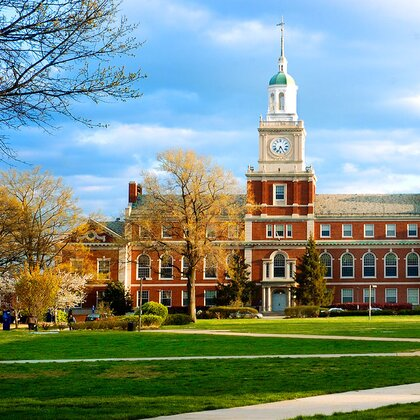
Howard University just had its most consequential year in decades. In early 2025, Howard became the first HBCU to achieve R1 Carnegie Classification — a designation reserved for universities with the highest levels of research activity. Later that year, MacKenzie Scott donated $80 million to the university, one of the largest gifts in Howard’s history. It is, in every measurable sense, a university on the rise.
American University, Georgetown, and GWU are all operating in a metro area where the applicant pipeline is growing, federal policy intersects with every major academic discipline, and the density of internship and career opportunity is virtually unmatched. DC’s +31% isn’t a recruitment opportunity in the traditional sense — it’s a signal about what kind of higher education ecosystem students are buying into when they choose to study there. The market is growing, the institutions are investing, and the competition is real.
What This Actually Means for Your Application Strategy
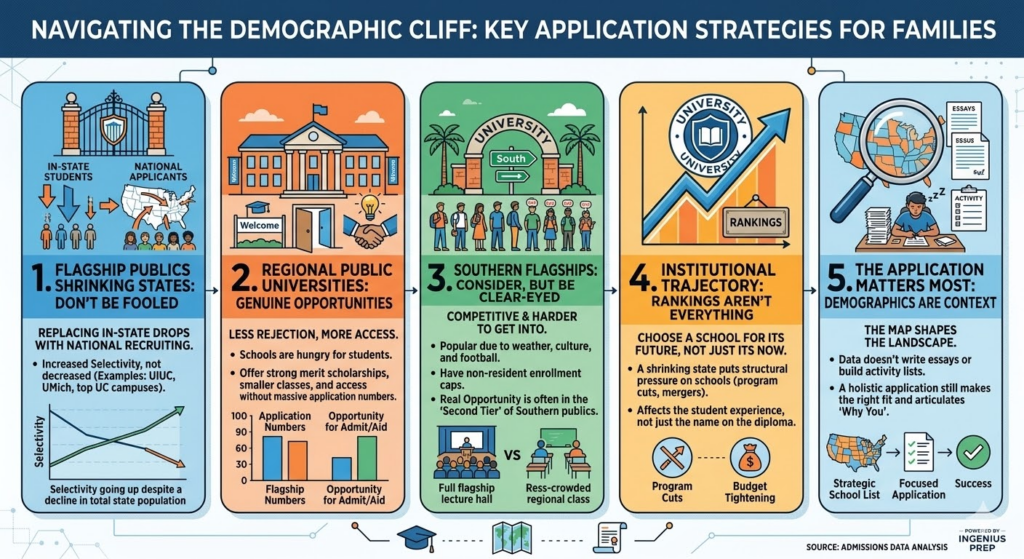
Reading this data as a family, a few things should become clear:
Flagship public universities in shrinking states are not becoming easier. They are replacing their shrinking in-state pools with national applicants, and the result — in most cases — is increased selectivity, not decreased. UIUC, UMich, and the UC system’s most competitive campuses are all examples of this dynamic playing out in real time.
Regional and non-flagship public universities in declining states represent genuine opportunity. These schools need students, and they are increasingly willing to compete on price and program quality to attract out-of-state talent. For the right student, they offer access to a respected university degree, strong merit scholarships, and smaller class sizes — without the rejection rate of a school processing 70,000 applications a year.
Southern flagship schools are legitimately worth considering — but go in clear-eyed. They’re competitive, they have enrollment caps, and the cultural draw that makes them attractive is the same force that’s made them harder to get into over the past decade. The second tier of Southern publics is where the demographic math works most obviously in an out-of-state applicant’s favor.
Institutional trajectory matters as much as current rankings. A school in a state that’s projecting 20–30% fewer graduates over the next 15 years will face real structural pressure — program cuts, potential mergers, and budget tightening. That affects the experience you have, not just the name on your diploma. Choosing schools requires thinking about where they’re headed, not just where they are.The map is context. The application is still the thing. Demographic data shapes the landscape. It doesn’t write the essay, build the activity list, or articulate why a particular school is the right fit. What the data does is give families a more honest picture of where competition is actually easing — and where the perception of ease is outrunning reality.
At InGenius Prep, this kind of structural analysis is part of how we build every student’s school list — not just looking at acceptance rates in isolation, but understanding what’s driving them and where the real openings are. If the data in this piece raised questions about how the demographic landscape should shape your own strategy, we’d love to talk.